Stone Temple Gardening — A Few Words at the End of 2025
Updated: May 5

“Welcome to Stone Temple Gardening, where we dig deep into the rich soils of prehistory to cultivate new ways of understanding the ancient past.”
Many of the videos on the Stone Temple Gardening YouTube channel link directly to blog posts below, allowing ideas to move back and forth between writing, walking, and conversation. Here.
Stone Temple Gardening began quietly in 2024, as a way of keeping notes while walking ancient ground — a place to think out loud,to integrate a lifetime of observation and reading on prehistory, and to share insights that didn’t fit easily elsewhere. It was never intended as a statement or a system. Over time, and largely thanks to those who returned to read, it became something more shared.
So as 2025 draws to a close, I want to pause and say thank you.
My thanks are not abstract. This work has been shaped by people — through generosity, conversation, challenge, and trust. I am especially grateful to Dr. Mike Woods, Professor Terence Meaden, and author Alun G. Rees, not only for their scholarship, but for their openness in sharing time, insight, and disagreement without demanding closure or certainty.
I also want to thank the online communities that allow this work to circulate, be tested, and sometimes be corrected. In particular, the Facebook groups run by Hugh Newman (Megalithomania); Neil Mancini (Ancient and Sacred Avebury and Wiltshire Landscapes); Graham Allen (British Long Barrows); Phil Glover (Standing Stone Faces); Máirtín Ó Broin (The Irish Megalithic Research Group); and everyone at The Northern Antiquarian. There are many others too. I thank you all.
These spaces really matter. They bring like-minded people together. They keep ideas porous, grounded, and accountable. Whatever value this work has comes in no small part from being exposed to readers who care enough to look closely, argue well, and keep returning.
And especially to those who return, who take the time to comment, to question, to disagree, or simply to say that something here resonated — thank you. Knowing that the work is being read slowly and with care, rather than skimmed and consumed, has been one of the quiet rewards of this year.
Every message, disagreement, and quiet reader has shaped the way this work has unfolded. This has never felt like broadcasting answers. It has felt like walking together — sometimes in agreement, sometimes in productive tension, often in silence.
If there is a thread running through the year, it is this: I do not feel more certain than I did at the start — only more aware. That awareness, once established, proved portable. It carried from Britain into wider landscapes further afield, without losing its grounding.

Highlights from the Year
All my observations on the Welsh passage tomb of Bryn Celli Ddu this year took place over four wonderful sunny days at midsummer. That concentration was important. Post: Bryn Celli Ddu solstice
Raher than a long, seasonal return, this was an intense and continuous period of walking, watching, and returning — moving repeatedly between monument, outcrop, surrounding fields, and excavation context, allowing understanding to build through proximity rather than distance.
It was over these four days that my pivot toward phenomenology was quietly secured — not as a theory adopted in advance, but as something that emerged through experience. By phenomenology, I simply mean paying close attention to how a place is actually experienced: how stones change as you move around them, how light, scale, sound, and bodily position shape what becomes visible or meaningful. It treats perception not as a distraction from archaeology, but as one of its original conditions.
Within the same short span came an encounter at Lligwy Burial Chamber, which became its own blog post and proved unexpectedly decisive. Post:Lligwy Burial Chamber – The Bear Simulacrum
At one end of the capstone, the stone resolves — from certain angles and distances — into a bear-like form, a simulacrum that does not announce itself immediately, but insists once seen. It is not carved or declared. It emerges through position, light, and stance.

That same quality of regard carried back to Bryn Celli Ddu itself. At the Sunstone, faces and forms again appear and dissolve as light shifts and the viewer moves. Nothing is fixed. Perception does the work. Post: Sunstone and faces at Bryn Celli Ddu / Gorsedd reflections]
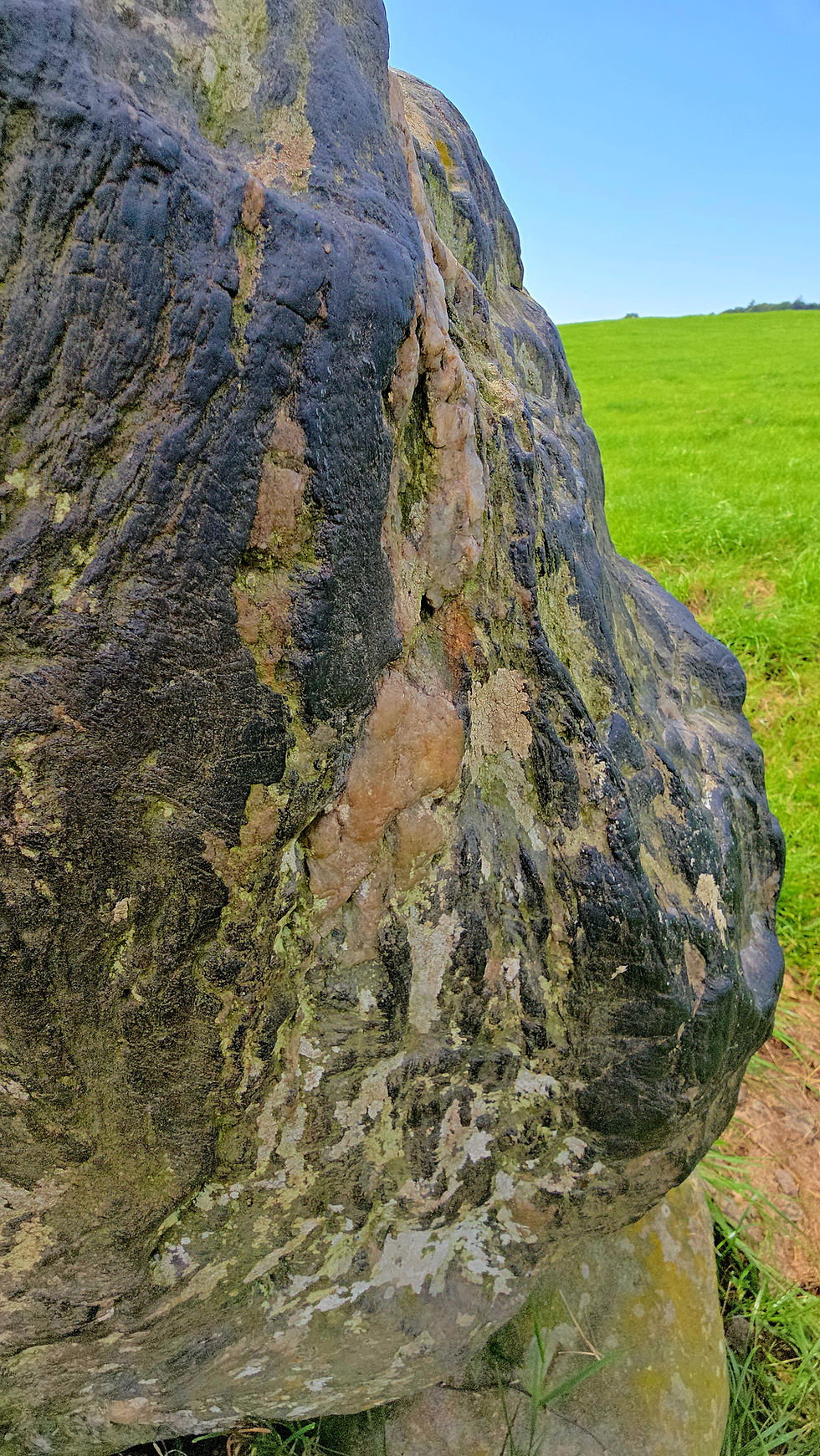
Looking back from the monument toward the Gorsedd outcrop, this logic extends beyond individual stones to the wider landscape. From that direction, the outcrop presents a suggestion of a profile looking skyward — subtle, contingent, and dependent on stance and horizon. Once noticed, it is difficult to unsee.
Taken together — the Sunstone’s emergent faces, the Gorsedd’s upward-looking profile, Lligwy’s bear, and the solstitial light within the chamber, these encounters clarified something essential. Meaning at Bryn Celli Ddu does not reside solely in archaeological deposits, alignment, carving, or architecture. It arises in the relationship between body, stone, light, and landscape position. The monument did not simply frame my vision; it trained it.
I owe particular thanks here to Dr. Mike Woods, whose generosity with his time and knowledge helped me better understand the archaeology of the site and its wider context. Being invited to observe and engage with the dig at Tyddyn Bach above the main site grounded these perceptual insights in practical reality. Post: Has a Lost Stone Circle Been Found at Bryn Celli Ddu?
If the Anglesey writing worked at all this year, it is because it was shaped in a dialogue between monuments, excavation, landscape, and moments of recognition that could not be forced, only noticed.

Stonehenge
The post Stonehenge Cosmology: The Temple We Are Not Allowed To See came from a place of frustration, but also from care. Post: Stonehenge Cosmology: The Temple We Are Not Allowed To See
Here, this blog along with the Stone Temple Gardening YouTube channel became especially important.

Conversations and time spent with Terence Meaden reinforced the value of careful observation, walking, pausing, and thinking, even when official narratives feel closed. The post explored the official vs critical accounts of Stonehenge and underlined my well developed insider knowledge of some of the faults of professional academia. Terence's ideas and evidence have been too often ignored. I would like to thank Terence again for his help, insight and generous time given to enrich my reseach. YouTube: Inside Stonehenge with Terence Meaden where he highlights his new discovery of a phallic stone at Stonehenge.
If Stonehenge appears less often on the blog than readers might expect, it is not from lack of interest, but from respect for its complexity and difficulty of interpretation as well as an awareness there is already a vast corpus of information on this most singular of monuments. What really made this post and video stand out was it was genuinly new information backed by an Iron Age historical account, as well as physical evidence at stonehenge for all to see who care to look. All is revealed in the video. And you saw/read it here first.

Avebury
Avebury offered something gentler this year, but also something quietly insistent.
Walking the avenues and stones repeatedly, it became difficult to ignore how replete the landscape is with simulacra — faces, profiles, animal forms, and presences that emerge and recede depending on movement, distance, and light. Posts: Avebury Circle Faces in Stone; The Avenue; West Kennet Long Barrow
Conversations and time spent with Alun G. Rees about his new book Stonehenge Deciphered unfolded against this inside Avebury. Post; Interview at Avebury with Alun G. Rees
By this point in the year, the experience-led way of seeing first secured at Bryn Celli Ddu had become a preoccupation rather than just a possibility.
Stretching Out
Earlier in the year, the project began to stretch beyond Britain, not as a change of direction, but as an extension of the same care carried elsewhere.
Time spent at the sacred Javan terraced monument Gunung Padang marked the beginning of that outward movement. I had wanted to visit for some time as it is not too far from family, and 2025 provided an opportunity. Few places benefit more from being written about by someone who has actually stood on the terraces themselves. Video to follow but post here. Post: Gunung Padang

This new thread will continue into forthcoming posts on Ayutthaya Historical Park, Sukhothai Historical Park, and Angkor Wat all of whom I have visited and recorded in the past.
Ideas for 2026
What emerged at Gunung Padang also sharpened how I began to think about the year ahead.
The year ahead will not be organised around monuments alone, but around relationships — between stone and horizon, land and sky, form and perception.
Alongside visits to circles, barrows, caves, and landscapes, I’ll be paying close attention to how light moves through these places: sunrise and sunset, seasonal drift, shadow, glare, and alignment — not as fixed claims, but as lived experience.
Stone circles such as Stanton Drew, Mitchell’s Fold, Arbor Low, The Nine Ladies, as well as the long barrows of the Cotswolds — Hetty Pegler’s Tump, Belas Knap, Nympsfield Long Barrow, Notgrove Long Barrow — will be approached not simply as structures, but as experiences embedded in their landscape and the perceptions they stimulate. I visited and recorded them all of these this summer.
The work will also extend into landscapes where architecture gives way to geology: Creswell Crags, Stanton Moor and the nearby Robin Hood’s Stride.

Epilogue
The solstice reminds us that time is not only counted, but felt.
If you have been reading for a while, thank you for staying with this work as it has grown more observant, and more open-ended. If you are newer here, you are also very welcome and I hope you will stick around and share your thoughts.
As the year turns, I invite you to revisit the blog, browse older posts, follow threads that interest you.
Stone Temple Gardening remains a work in progress — shaped by stones, weather, walking, and by those who choose to travel with me.
Thank you — and happy new year!
Read on
If you’re interested in how my thinking has shifted over time, you might also want to read an earlier winter essay from last year, written before many of the experiences described above: Post: Solstice Rites and Winter Nights
Alex Peach
December 2025
Stone Temple Gardening is built through fieldwork: walking, filming, photographing and testing prehistoric landscapes on the ground. If this work interests you, you can support future site visits and research here.


Terrific article and photos