Megalithomania 2026 in Glastonbury: Sacred Landscapes, Ancient Sites and Stone Temple Gardening
Updated: Jun 5

This post is a personal review of Megalithomania 2026 in Glastonbury, written from the perspective of Stone Temple Gardening. It follows the Friday Abbey and Tor walk, the first full day of lectures, and the way the conference connected sacred landscape, archaeology, archaeoastronomy, folklore, sound, myth and field observation. I would like to personally thank conference organiser Hugh Newman for kindly giving me permission to use Megalithomania brochure images in this post.
Glastonbury, Sacred Landscape and the Setting for Megalithomania 2026
Glastonbury is never just a backdrop, and for Megalithomania 2026 it felt like the perfect sacred centre. It is one of those places where landscape, myth, history and pilgrimage seem to press in from every direction. However you approach it, the Tor rises above the town and surrounding levels like a spiritual lighthouse, drawing the eye and the imagination towards Avalon.
At the heart of the town is the now ruined Abbey, around which Glastonbury itself grew. It still holds the memory of saints, kings, legends such as the grave of King Arthur, Reformation ruin and reinvention. The surrounding levels, hills, ancient tracks and mythical stories give the whole place a sense of depth that is difficult to separate from the land itself. To arrive there for Megalithomania 2026 felt entirely appropriate. This was not simply a conference held in Glastonbury. It was a gathering of people drawn to ancient sites, sacred landscapes, earth mysteries, archaeology, astronomy, folklore and the long human need to find meaning in place.

Megalithomania has become one of the key meeting points for this wider world of stones, monuments and ancient landscapes. Founded in 2006 by Hugh Newman, John Martineau and Gareth Mills, it brings together researchers, writers, filmmakers, field investigators and enthusiasts who approach the prehistoric past from many different angles: archaeology, archaeoastronomy, mythology, geometry, symbolism, earth mysteries and independent research. That range is part of its strength. It creates a space where ideas can be tested, challenged, shared, and then carried back out into the field.
This year it celebrated its 20th anniversary, and for me it was a fourth visit to what now feels like an omphalos, a sacred centre, for modern antiquarian research, speculation and friendship. In Glastonbury, a town already thick with centre-symbolism, pilgrimage and sacred geography, the word did not feel misplaced.
This is the first of several posts on Megalithomania 2026. It covers my journey into Glastonbury, the Abbey and Tor walk, and the first full day of the conference. Sunday’s lectures, a fuller essay on Stoney Littleton Long Barrow, and the field trips to Uley, Rollright, Tinkinswood, Trellech, Maes Knoll and Stanton Drew will follow separately.
Megalithomania 2026 Review: A Stone Temple Gardening Perspective

For Stone Temple Gardening, this year’s conference came at exactly the right moment. My own work has increasingly moved towards the idea that monuments cannot be understood by looking at stones alone. The land comes first. Routes, ridges, rivers, hills, horizons, natural outcrops, thresholds and lines of movement all shape how a place is encountered long before a monument is built.
Megalithomania offered the chance to listen, learn, meet like-minded people, visit remarkable sites through the three organised side trips, add two further visits of my own, and test those ideas across several days of real landscapes and informed conversation.
What followed was far more than a weekend of lectures. It became a journey through barrows, stone circles, standing stones, hillforts, sacred hills, river crossings and old routeways. From Stoney Littleton on the way down, to Glastonbury itself, to Uley, Rollright, Tinkinswood, Trellech, and finally Maes Knoll overlooking Stanton Drew stone circles, the whole trip began to unfold as a connected landscape experience. At Maes Knoll in particular, I had the chance to test a possible route of approach towards Stanton Drew, looking down from the hillfort across the valley, river crossing, Hautville’s Quoit and the circles beyond.
The conference gave the ideas. The tours gave them ground. The conversations in between gave the whole event its energy. And somewhere among the lectures, coach journeys, site visits and shared obsessions, I made some new stoney friends.
Before Glastonbury: Stoney Littleton Long Barrow

My first stop on the way down from the Midlands was Stoney Littleton Long Barrow, near Wellow in Somerset. It was a fitting beginning. The journey from the motorway quickly left the modern road system behind, crossing ridges, valleys and narrow lanes before reaching the Wellow landscape. I will return to Stoney Littleton in a separate Stone Temple Gardening essay, because the site deserves fuller treatment: the steep climb from valley to ridge, the hidden barrow revealing itself at the top, the low constricted entrance, the ammonites caught in the stone, and the strange sense that the journey to Megalithomania had begun before I ever reached Glastonbury.
For this post, it is enough to say that Stoney Littleton gave the day its first movement: river, valley, climb, ridge, chamber. It was a reminder, before the conference even began, that monuments are never only monuments. They are approached, entered, revealed and remembered through landscape.
I made a short video of my visit below.
Arrival in Glastonbury: Abbey, Tor and New Friends

From Stoney Littleton I continued on towards Glastonbury, carrying with me the sense that the journey had already begun in the right key. The long barrow had already set the rhythm of the day: river, valley, climb, ridge, chamber. By the time I reached Glastonbury, the sun was still high, the sky bright, and the town was glowing in that particular way it has when the Tor stands clear above the rooftops and the levels beyond.
I checked into my Airbnb, dropped my bags, and headed almost straight back out again for the first Megalithomania gathering: the guided walk around Glastonbury Abbey and the Tor. It was here that the social side of the week began properly. I met many people but began and what started as a casual conversation before the tour became five days of shared lectures, coach journeys, site visits, conversations, jokes and friendship. These things matter at events like this. Megalithomania is not only about speakers and sites. It is also about the temporary community that forms around them.
The Friday tour began in the Abbey grounds, with a detailed and entertaining introduction to Glastonbury’s history, myths and legends. Our guide Paul Weston led us through the layered story of the Abbey: its Christian foundations, Arthurian associations, medieval power, destruction, survival and reinvention. Glastonbury is never easy to separate into history on one side and legend on the other. The two are too closely woven together. That is part of its force.
From the Abbey we made our way up the Tor, climbing from the town into the wider sacred geography that gives Glastonbury its shape. The walk continued in the same spirit: part history, part myth, part landscape encounter. Standing above the levels in glorious sunshine, with the town below and the countryside opening in every direction, it felt like the perfect beginning to the conference. Before the lectures began, before the coach tours and site visits, Megalithomania had already placed us where we needed to be in the landscape, among stories, and in conversation with people who had come for the same reason.
Saturday Morning in Glastonbury
After an early night, I was up bright and early for the first full day of the conference. Glastonbury was bathed in sunshine and already buzzing with tourists, locals, pilgrims, shoppers and seekers. The town has a very particular morning energy during Megalithomania. People gather outside cafés with programmes in hand, old friends recognise each other in the street, and conversations about stone circles, earth energies, ancient astronomy and forgotten histories seem to start before breakfast.
Walking through the town, I drifted back to my first visit in 1984, when Glastonbury’s alternative world felt concentrated around one magical emporium: Gothic Image. Yes, I am that old. Back then, it seemed like a doorway into another way of seeing Britain. Now the whole town feels like it has become that doorway. Almost every shop window offers some variation of the same invitation: books, artworks, crystals, handmade astrological incense, candles, herbs, spells, oracle cards, ritual clothing, and even a cauldron if you suddenly realise you have left yours at home.

Glastonbury has become a mecca for all things New Age, pagan, mystical, therapeutic and esoteric. The local events magazine, The Oracle, reads like a map of this alternative universe, advertising fairy festivals, Goddess temples, tantric shops, sensual awakening workshops, therapies, ceremonies, talks and gatherings of every imaginable kind. It would be easy to mock, and many do. But that would miss something important. Whatever one thinks of the crystals, cauldrons and incense, Glastonbury remains a place where people come looking for meaning, healing, connection and a deeper relationship with landscape, myth and spirit.
That made it the perfect setting for the 20th anniversary of Megalithomania. The conference sits within this wider Glastonbury atmosphere, but it also gives it a sharper focus. Here the interest in ancient places becomes lectures, arguments, evidence, speculation, fieldwork, books, films and long conversations in the breaks. The weekend would bring speakers from very different worlds, from archaeoastronomy and sacred geometry to independent research, earth mysteries and global myth. But before the first lecture even began, the town itself had already made the point. Glastonbury is not only a location for Megalithomania. It is part of the experience.

Walking up to the Town Hall, where the conference was being held, I met up again with the friends I had made on the previous evening’s tour. We found seats together, and the weekend began properly with Hugh Newman’s introduction.
Stuart Mason: The Long Man of Wilmington and Landscape Astronomy

The first speaker was Stuart Mason, whose talk on the Long Man of Wilmington immediately felt relevant to Stone Temple Gardening. His presentation explored the famous Sussex hill figure on the chalk slopes of Windover Hill, now marked in white-painted concrete blocks but still visually bound to the downland landscape around it. Mason argued that the Long Man may have functioned as a kind of monumental celestial timekeeper, marking key solar and lunar moments within the surrounding landscape.

A central part of the argument concerned the way shadows are cast at the site. At particular moments in the year, these shadow effects appear to indicate important astronomical events, with the Long Man acting as a visible marker within a much larger system of land and sky. There was far more to the talk than this, though. It was not simply about alignment. It was about landscape, movement, thresholds and sightlines: how people approached the figure, how the surrounding features shaped attention, and how the hill itself may have worked as part of a ritual and cosmological field.
That idea felt very close to my own developing work. The Long Man, in this reading, is not just an image placed on a hillside. It is a figure held within land, horizon and sky. The landscape features around it all seem to work together, turning the hill figure into part of a larger design. Mason described it as something like Britain’s Stonehenge of the east, a bold phrase, but one that made sense within the argument he was building.
Stuart Mason brings together folklore, archaeoastronomy, ancient cosmology and long experience of landscape research. His work on lunar cycles, solstices, navigation and sacred time gave the talk real depth, but what stayed with me most was the central point: the landscape itself may be the instrument. The figure, the horizon, the seasonal turning points, the casting of shadow and the movement of people all belong together.
It was a strong opening lecture for the conference, and for me a perfect one. Before the weekend had really begun, Megalithomania had already placed one of Stone Temple Gardening’s central questions on the table: what happens when we stop looking at ancient monuments as isolated objects, and begin reading them as part of a living relationship between land, sky and human attention?
Paul Weston: Psychic Questing and the Earth Mysteries Tradition

Next up was Paul Weston, who had guided us so well around Glastonbury Abbey and the Tor the previous evening. His talk moved into very different territory: the Circle of Perpetual Choirs, the Giza Plateau, and the psychic questing work associated with Andrew Collins in the 1990s.
Psychic questing is not really my own field, but I am interested in the anthropology of how landscapes affect people: how places gather attention, alter perception, generate stories, invite ritual action and become charged with meaning over time. In that sense, Paul’s talk still touched on questions that matter to Stone Temple Gardening, even if it approached them through a very different tradition.
That breadth is part of what makes Megalithomania interesting. Its remit is deliberately wide. Archaeology, archaeoastronomy, folklore, geometry, myth, personal experience, Earth Mysteries and visionary traditions all rub shoulders here. Some talks speak directly to my own work. Others open windows into areas I know less well.
Paul’s presentation gave a glimpse into a particular moment in the recent history of Earth Mysteries: the 1990s world of psychic questing, ritual landscapes, the Circle of Perpetual Choirs, John Michell’s influence, and Andrew Collins’ wider Giza work. It showed that ancient landscapes have not only been studied from the outside. They have also been entered imaginatively, ritually and experientially by people trying to find meaning within them.
That, for me, is where it fitted into the wider conference. The ancient landscape attracts more than one kind of attention. Some come with maps and measurements. Some with myth. Some with ritual. Some with questions that sit somewhere between all three. Megalithomania gives space for that range, and Paul’s talk was a clear example of its eclectic spirit.
Juliette Bryant: Mycelium, Mushrooms and Sacred Ecology

Next up was Juliette Bryant, whose presentation also came from a more spiritual and experiential angle, this time through mushrooms, mycelium, nutrition, earth wisdom and sacred landscapes.
This also came from outside my usual area of research, but it touched on questions that do interest me: how human beings experience landscape, how non-human life shapes consciousness, and how older cultures may have understood themselves as part of a wider living ecology. Juliette’s talk moved between the science of mycelial networks, the nutritional and medicinal properties of mushrooms, and a more intuitive or spiritual sense of encounter with the living Earth.
There was also a discussion of altered states and mushrooms, which needs saying carefully. Juliette was not simply advocating casual psychedelic use, and neither am I. But when thinking about prehistory, the subject cannot be dismissed too quickly either. Many ancient cultures understood plants, fungi, ritual, fasting, darkness, sound, movement and place as part of a larger field of experience. Whether or not mushrooms played a role in specific prehistoric contexts is a question that requires caution, evidence and restraint, but the wider issue of altered perception and sacred landscape is certainly relevant.
For Stone Temple Gardening, the most interesting part was not the claim that one specific substance explains ancient monuments. I do not think it does. It was the broader idea that human beings experience landscape through the whole body: through food, ecology, sensation, attention, memory, ritual and relationship with the more-than-human world. Mycelium also offers a powerful metaphor, and perhaps more than a metaphor, for hidden connection: networks beneath the surface, linking trees, soil, decay, nourishment and renewal.
Like Paul Weston’s talk before it, Juliette Bryant’s presentation showed another side of Megalithomania’s deliberately broad character. Some talks come through archaeology or archaeoastronomy. Others come through earth spirituality, ecology, healing traditions or altered states of awareness. I do not approach these areas in quite the same way, but they do form part of the wider cultural and anthropological story of how people continue to seek meaning in ancient places.
Books, Art and the Megalithomania Market
During the lunch break I explored the market attached to the conference. It was full of books, T-shirts, artwork, crafts and the sort of stallholders you only really find at events like Megalithomania: knowledgeable, enthusiastic, slightly eccentric in the best possible way, and always ready for a conversation. I bought a signed copy of Stuart Mason’s new book on the Long Man of Wilmington, Britain’s Stonehenge of the East, which felt appropriate after such a strong opening lecture.
Hugh Newman: The Olmec World of Mexico

After lunch came conference organiser Hugh Newman, who shifted the focus far beyond Britain and into the Olmec world of Mexico. Hugh has been travelling in Mexico since 2009, and his talk drew on recent fieldwork around the Gulf Coast, including visits to rarely seen Olmec sites, quarry landscapes and new discoveries made with archaeologists and fellow researchers. The result was a presentation full of photographs, travel, field observation and the kind of on-the-ground investigation that has always been central to his work.
The Olmec are often overshadowed by later Mesoamerican cultures, yet their monumental heads, carved stonework, ritual centres and sophisticated landscape settings suggest a civilisation of remarkable complexity. Hugh’s talk brought that world vividly into the room. There was a strong sense of him not simply reporting from books, but from tracks, quarries, museums, private land, conversations with local experts and long journeys through the landscape itself.
For me, the most interesting part was the way the talk widened the frame of the conference. Megalithomania is rooted in ancient stones and sacred landscapes, but it is not confined to Britain. Hugh’s work constantly pushes outward, linking monumentality, myth, stonework, lost histories and field exploration across the world. Whether in Anatolia, Mexico or the British Isles, the same larger question keeps returning: why did human societies invest so much effort in stone, place, memory and sacred architecture?
It also underlined Hugh’s particular role in all this. As organiser, author, filmmaker and field researcher, he is not simply hosting the event. He is part of the movement that keeps it alive, drawing together speakers, researchers and audiences who may not agree on everything, but who share a fascination with ancient places and the mysteries they continue to hold.
J.J. Ainsworth: Ancient Sky Symbolism and Karahan Tepe
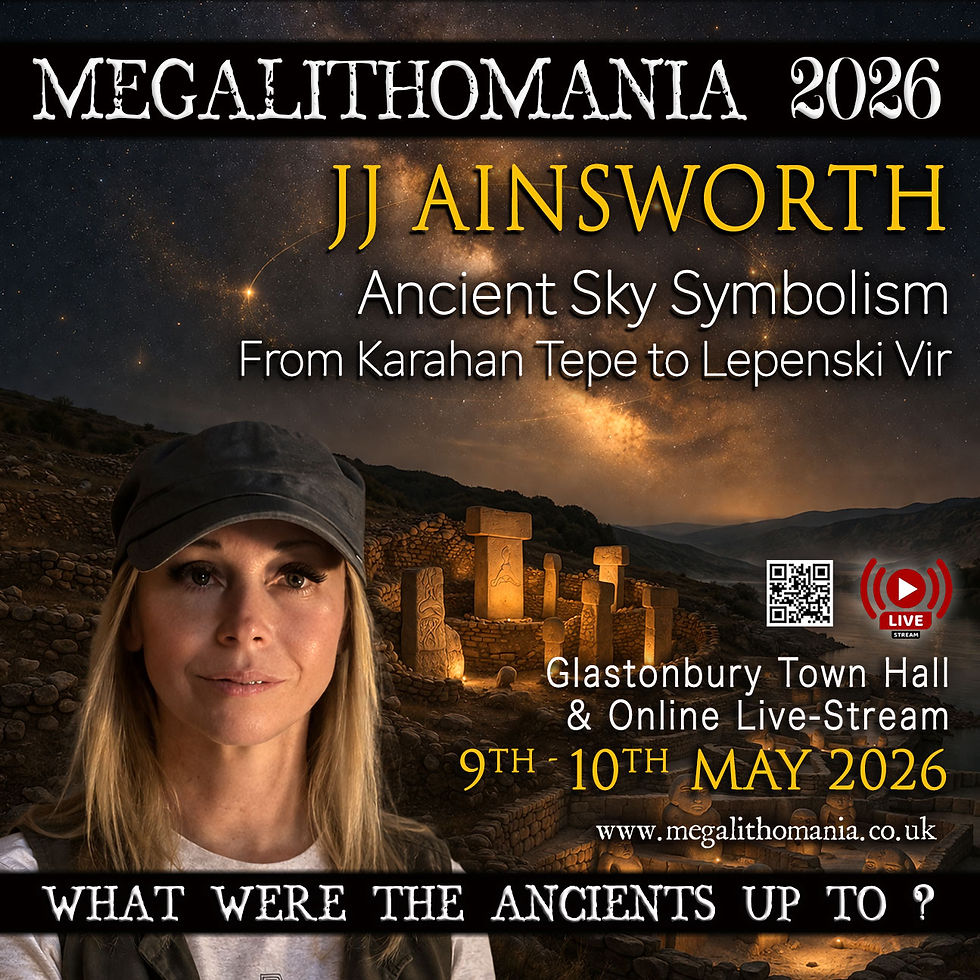
Next came J.J. Ainsworth, with a talk titled Ancient Sky Symbolism from Karahan Tepe to Lepenski Vir. This was one of the most stimulating presentations of the day, moving across deep prehistory, symbolism, ancient sites and sky knowledge with real energy.
The clearest and most memorable part for me was her explanation of precession: the slow wobble in the Earth’s rotational axis that changes the position of the stars over very long periods of time. It is not always an easy concept to explain clearly, but this was one of the best descriptions of it I have heard. She made the vastness of the timescale understandable without losing the wonder of it.
The talk ranged from Karahan Tepe in Turkey to Lepenski Vir on the Danube, looking at ancient symbolism, cosmology and possible links between monuments, images and the sky. It was eclectic, informative and genuinely thought-provoking, exactly the kind of presentation that suits Megalithomania at its best.
One of her most interesting contributions concerned the winter solstice light effect at Karahan Tepe, discovered by her through on-site observation with Hugh Newman. At the solstice, sunlight enters the sacred enclosure and illuminates a carved head, turning the architecture into an event rather than just a structure. This connected directly with Stone Temple Gardening, because it shows why field observation is essential. Some relationships between monument, light, carving and season can only be recognised by being there, at the right time, watching what the place actually does. It reinforced one of the core lessons of the whole weekend: ancient places are not fully understood from plans, photographs or theories alone. They have to be encountered.
Simon Banton: Stonehenge, Moonset and the Station Stones
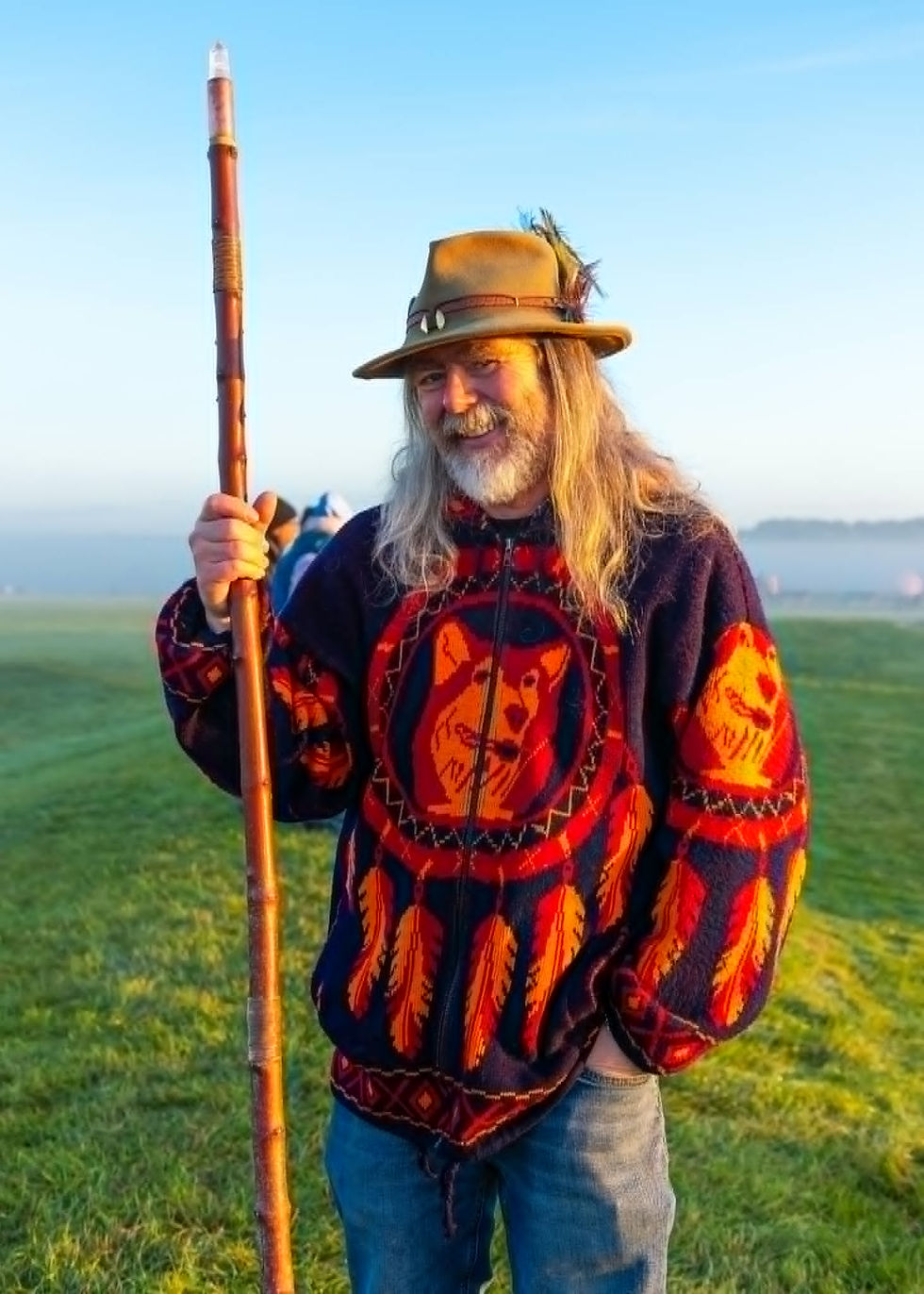
Fabio Silva was scheduled next, but unfortunately had to cancel due to ill health. In his place we had Simon Banton, whose presentation took us deep into the archaeoastronomy of Stonehenge, especially the Station Stones and the major lunar standstill of 2024 and 2025. Hats off to Simon for stepping up to the plate at such short notice!
This was a fascinating and very Stone Temple Gardening presentation. Simon spoke with real depth of knowledge, far too much to convey properly in a short summary. The strongest point for me was his emphasis on the Moon, and particularly on moonset, as a crucial part of the Stonehenge alignment question. Stonehenge is so often reduced to the summer solstice sunrise and winter solstice sunset axis, but his talk opened the monument out into a much wider astronomical and landscape field.

The Station Stones were central to this. Their rectangular arrangement has long been discussed in relation to lunar extremes, and Simon brought that debate into the present through observations connected with the recent major lunar standstill. He also described his own fieldwork, including the finding and recording of a notch alignment, a detail that felt especially important. It was exactly the kind of careful, place-based observation that Stone Temple Gardening depends on: not just theory imposed on a site, but something noticed, checked and recorded through direct encounter with the landscape.
Simon then moved into the question of the Altar Stone, its reported origin in north-eastern Scotland, and the possibility of a lost companion stone removed from the site in the seventeenth century. He explored where these stones may once have stood and what role they might have played within the monument.
There was much more in the talk than I can do justice to here, but it was one of those presentations that reminded me how alive Stonehenge still is as a research problem. The monument is not exhausted by the familiar postcard image. It remains a place of sky, horizon, movement, sightline, stone and argument.
I was also able to talk to Simon a couple of times over the weekend, and both conversations were extremely informative. His combination of detailed field knowledge, astronomical awareness and close attention to the Stonehenge landscape made this one of the most useful sessions of the conference for my own work.
Andrew Collins: Stonehenge Acoustics and the Sonic Temple

Last up on Saturday, and in many ways one of the keynote speakers of the day, was Andrew Collins, with a wide-ranging presentation titled Stonehenge: Sonic Temple and Universe in Stone.
The talk began in territory that felt highly relevant to Stone Temple Gardening: the acoustic properties of Stonehenge and other ancient monuments. Collins touched on work by researchers including Paul Devereux, Steve Marshall, Aaron Watson, Rodney Hale and Professor Trevor Cox, whose acoustic modelling of Stonehenge has helped show how the monument may have amplified and shaped sound within the stone circle.
This is an area I am increasingly interested in. If Stone Temple Gardening asks how landscape affects human attention, then sound has to be part of that question. Stonehenge is not only seen. It is heard. Voice, rhythm, echo, resonance, enclosure and acoustic contrast may all have shaped the experience of standing within the monument. Some acoustic studies suggest that the sarsen setting would have reinforced sound inside the circle while limiting how clearly it carried beyond it, which raises fascinating questions about participation, control and ritual experience.
Collins then widened the talk into more esoteric readings of sound, consciousness, geometry and cosmology. This included geomancy, Plato’s Timaeus, Keith Critchlow and symbolic readings of number and form. Some of this moved beyond the areas I normally work with, but it was still part of the conference’s wider character. Megalithomania has always made room for the point where archaeology, Earth Mysteries, geometry, archaeoastronomy and visionary interpretation meet.
For me, the strongest element was the acoustic material. It connected directly with a developing STG question: were some monuments designed, or later discovered, as places that changed perception through sound? Not just visual alignments, but resonant architectures. Not only stones in space, but stones that altered voice, rhythm, presence and attention. On that level, Collins’ talk was a fitting end to the first day: ambitious, provocative, sometimes speculative, but full of ideas that kept turning over long after the session ended.
Megalithomania 2026 Saturday: Stones, Skies, Sound and Sacred Landscapes

I ended Saturday tired but energised. The day had moved from the Long Man and landscape astronomy, through Earth Mysteries, mycelium, Olmec stonework, ancient sky symbolism, Stonehenge moonsets and acoustic resonance. It was eclectic, sometimes speculative, often fascinating, and exactly the kind of intellectual weather Megalithomania exists to create.
Sunday would bring a different rhythm: older lineages of Earth Mysteries research, sacred geometry, the Megalithic Portal, strange traces of sacred difference, and finally a conference forum that drew the weekend’s themes together. But by the end of Saturday, Megalithomania had already done what it does best. It had filled the room with stones, skies, stories, arguments and possibilities.
Coming Next: Sunday Lectures and Megalithomania Field Trips
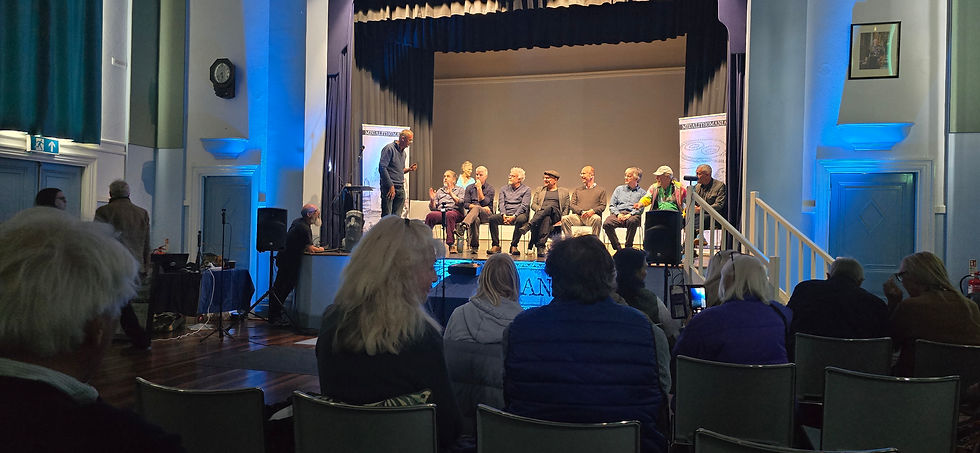
Sunday would take those questions further, into megalithic science, sacred geometry, ancient measure, the Megalithic Portal and the older lineages of Earth Mysteries research. But for now, Saturday had done more than enough. It had filled the room with stones, skies, sound, stories and possibility. For Stone Temple Gardening, it confirmed the central lesson again: the monument is never alone. The land, the sky, the path, the voice and the gathered people all matter. Megalithomania had properly begun.
Alexander Peach
Stone Temple Gardening
Megalithomania 2026
Stone Temple Gardening is built through fieldwork: walking, filming, photographing and testing prehistoric landscapes on the ground. If this work interests you, you can support future site visits, research and writing here.


Hello Alex and thank you for an interesting newsletter about the Megalithomania conference (which I attended three years ago). John Michell was a friend of mine and I first met him in 1985. My name is Martin Gray and I am a cultural anthropologist and National Geographic photographer specializing in the study and documentation of pilgrimage traditions and sacred sites around the world. During the past 45 year, I have been able to photograph more than 2000 pilgrimage sites in 160 countries, have published several books (including Geography of Religion, Sacred Earth, and Secret Sacred Sites). I also have a hugely visited website called World Pilgrimage Guide at https://sacredsites.com
I hope to hear from and meet you one day. This…
Thank you Alex!