Megalithomania 2026 Part 2: Sunday Talks, Sacred Geometry and the Mystery of the Stones
Updated: Jun 5
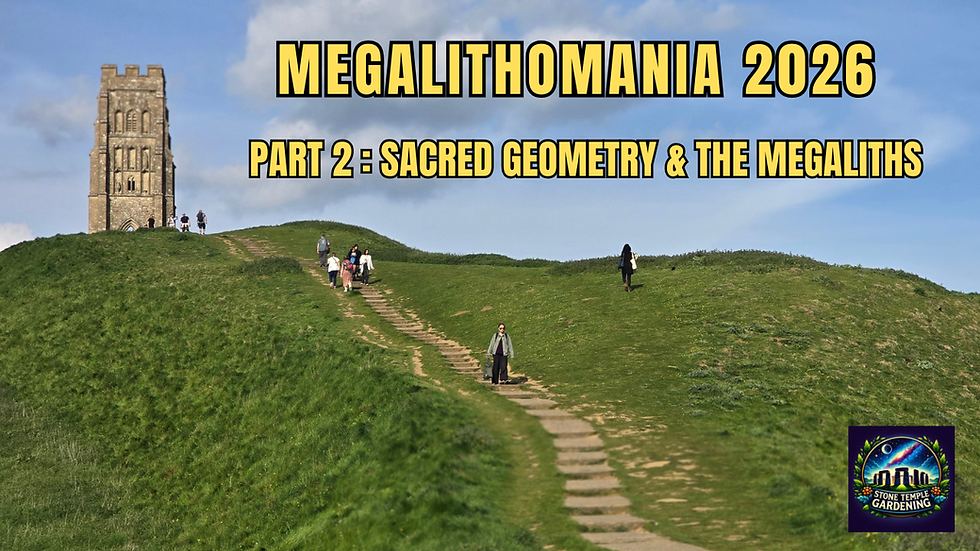
I would like to personally thank conference organiser Hugh Newman for kindly giving me permission to use Megalithomania brochure images in this post.
Welcome back to my Megalithomania 2026 write-up. This is the second part of my account of the Glastonbury conference weekend, focusing on the Sunday talks, the closing forum, and the ideas I carried away from the Town Hall before the field trips began.
If you missed the first part, which covers Friday’s arrival in Glastonbury, the Abbey and Tor walk, and Saturday’s lectures on landscape, sky, sound, Stonehenge, the Long Man of Wilmington, Karahan Tepe, mycelium, Olmec sites and acoustic resonance, you can read it here:
Saturday had opened Megalithomania 2026 with a rush of landscape, sky, sound and story. It set the tone for the weekend: wide-ranging, generous, speculative at times, but always circling the same essential question. How did ancient people understand the relationship between land, cosmos, monument and meaning?
Sunday felt different from the start. The first-day strangeness had gone. Faces were familiar now. Conversations resumed where they had paused the evening before, and the Town Hall no longer felt like a venue so much as a temporary meeting place for a scattered tribe of stone-watchers, sky-watchers, myth-hunters and landscape obsessives.
If Saturday had opened the field, Sunday began to deepen it. The second day would move through Waun Mawn and Stonehenge, sacred geometry, the Megalithic Portal, extra digits and sacred difference, ancient measure, John Neal, John Michell, and the older Earth Mysteries tradition from which Megalithomania partly emerged. It would be a day less about first impressions and more about inheritance: the ideas, lineages, friendships and questions that have kept people returning to stones, circles, numbers, skies and sacred landscapes for decades.
Then, after coffee and conversation with other attendees, we all filed in for our second day of serious Megalithica.
Sunday Morning: Robin Heath, Waun Mawn and Megalithic Science

After Hugh Newman’s short introduction, first up was veteran archaeoastronomer, pioneer landscape researcher and Megalithomania favourite Robin Heath, giving a recorded lecture on Megalithic Science at Waun Mawn and Stonehenge. For health reasons, he was unable to attend in person, but this did not detract from the presentation. Robin is an informed and entertaining speaker, and the recorded format still carried his usual clarity, humour and confidence.
Heath has spent decades arguing that prehistoric monuments preserve evidence of sophisticated astronomical, geometrical and metrological knowledge. With a background in engineering, mathematics and electronics, he approaches ancient sites through measurement, proportion, sky observation and fieldwork. That places him in a long Earth Mysteries and archaeoastronomical tradition, but also in a very practical one: go to the site, measure carefully, look at the horizon, test the geometry, and see what the place itself allows.
His focus here was Waun Mawn in the Preseli landscape of west Wales, and its much-debated possible relationship with Stonehenge. Mike Parker Pearson and colleagues have argued that Waun Mawn may once have formed a large stone circle around 110 metres in diameter, comparable in size to the enclosing ditch at Stonehenge, and that this may indicate a connection between the Preseli bluestone landscape and Salisbury Plain. (University of St Andrews Research Portal)
Heath’s reading was more sceptical of that reconstruction. Drawing on local knowledge, field measurement and his own approach to archaeoastronomy and geometry, he questioned whether the proposed reconstructed circle at Waun Mawn was the right way to understand the site. He was particularly alert to the danger of assuming that all the important evidence lies underground. For a landscape researcher, the visible terrain, horizon, surviving stones, geometry and setting matter too.
What made the talk interesting was not simply agreement or disagreement with Parker Pearson. It was the clash of method. One approach begins with excavation, stone holes and archaeological reconstruction. The other gives greater weight to field observation, measurement, landscape geometry and the experience of the site as it still stands. For Stone Temple Gardening, that distinction matters. STG does not reject excavation, far from it, but it does insist that ancient places also have to be read in the field, through movement, horizon, view, setting and the relationships still present in the land.
Robin also paid tribute to the recently deceased John “Nosher” Neal, a key figure in the Earth Mysteries world and in the study of ancient measure. Neal belonged to that important post-war and 1960s generation of researchers around John Michell and others, who helped reopen questions about metrology, geometry, sacred landscape and prehistoric knowledge. It was a generous and appropriate moment, reminding the room that Megalithomania is not only about new ideas, but also about the older lineages of independent research from which much of this field emerged.
As an opening to Sunday, it worked well. After Saturday’s movement through landscape astronomy, myth, mushrooms, Olmec stonework, Stonehenge moonsets and acoustic resonance, Robin Heath brought us back to one of Megalithomania’s recurring questions: how much did prehistoric people know about measure, sky and land, and how much of that knowledge still survives in the stones?
Nicholas Cope: Centre, Circumference and Sacred Geometry

Next up was Nicholas Cope, with a talk on Metaphysics, Symbolism, Centre and Circumference. I had few expectations of this lecture, but it turned out to be one of my favourite presentations of the whole weekend.
Cope came at the subject through sacred geometry, traditional art, metaphysics and symbolism. His background in fine art, Islamic art and traditional geometry gave the lecture a very different feel from the landscape and archaeoastronomy talks. This was less about one monument or one site, and more about the symbolic language that may lie behind sacred architecture and religious art more broadly.
At the heart of the talk was a simple but profound idea: the point and the circle. A compass begins with a fixed point, a centre, and from that point the circle is drawn. The point itself has no size, no extension, no part, as Euclid says. Yet from this almost nothing, the circle appears. Cope explored this as a metaphysical image: the point as formless origin, the circle as manifestation, unity, world, cosmos or universe. Nowhere generates everywhere.
That may sound abstract, but the lecture made it vivid through examples from sacred art, architecture, symbolism and ancient sites. It opened up the idea that geometry is not merely measurement. It can also be a language of religious philosophy expressed in space. In that sense, the circle is not simply a shape. It can become an image of wholeness, creation, order, return and unity.
This made me think hard about symbols themselves. Language can only go so far. At some point, symbolic form takes over. A point, a circle, a cross, a spiral, a set of concentric rings: these are not arguments in words, but they can still carry thought. Perhaps this is part of the power of sacred art, and perhaps also part of the power of prehistoric rock art. A cup-mark, a ring, a carved circle or a repeated concentric form may not need to explain itself in language to organise attention and meaning.
For my own STG work, this opened a useful line of thought. My work usually begins with landscape, movement, horizon and encounter, but Cope’s lecture suggested another layer: how abstract forms may formalise ideas of centre, boundary, origin and world. A stone circle, in this sense, is not only a monument in a landscape. It may also be a diagram of relation: centre and edge, inside and outside, stillness and turning, origin and circumference.
Cope also offered a geometric explanation for the mysterious Scottish Neolithic carved stone balls.
I wrote more notes on this talk in my journal than on any other lecture. It was a brilliant primer for anyone interested in sacred art, symbolism, geometry and the way metaphysical ideas can be expressed spatially. It also left me thinking about concentric circles in rock art, the symbolic force of circular monuments, and the possibility that some prehistoric forms may be read not only as marks, but as a kind of visual philosophy.
Andy Burnham: Thirty Years of Stone Hunting and the Megalithic Portal

My head was still whirling with Nicholas Cope’s ideas as we broke for coffee, and the conversation carried on among the delegates. That is one of the pleasures of Megalithomania. The lectures do not really stop when the speaker leaves the stage. They spill out into the foyer, the market, the coffee queue and the pavement outside.
After the metaphysical weight of centre and circumference, Andy Burnham provided a welcome change of tone. Andy is the founder of The Megalithic Portal, one of the key online resources for anyone interested in ancient sites, and editor of the community’s award-winning book The Old Stones. He had spoken at the first Megalithomania in 2006, so his return for the 20th anniversary gave the talk a pleasing circularity.
His presentation looked back over thirty years of stone hunting, and twenty-five years of running The Megalithic Portal. It was a lively mixture of archive photographs, early internet history, site visits, discoveries, theories, cartoons, jokes and affectionate self-mockery. My notes simply say: lovely light relief. That sounds casual, but it should not understate the importance of what he has built.
The Megalithic Portal is one of those resources many of us now take for granted. It gathers sites, photographs, maps, records, comments and community knowledge in a way that has helped countless people find, visit and think about ancient places. For independent researchers, walkers, photographers, writers and stone obsessives, it has become part of the working infrastructure of the field.
Andy’s talk was funny, knowledgeable and generous, but beneath the humour was a serious achievement. Building and maintaining a community resource over decades is no small thing. It requires persistence, technical work, editorial judgement, enthusiasm and an enormous amount of unpaid or underpaid care. Hats off to him.
I was able to speak to Andy later during the Cotswolds trip, which made this lecture feel even more useful in hindsight. For Stone Temple Gardening, The Megalithic Portal matters not only as a database of sites, but as an example of how independent research communities can gather, organise and share knowledge outside traditional academic structures. In its own way, that too is part of the Megalithomania story: people drawn to stones, building networks around them, and keeping the old places visible.
Jim Vieira: Extra Digits, Giants and Sacred Difference

The next lecture was by Jim Vieira, a familiar name in alternative archaeology and ancient mysteries circles. His talk drew on material from his latest book, Footprints of the Gods, co-authored with Greg Maestro, and focused on the global traditions surrounding polydactylism, or extra fingers and toes.
This could easily have been a subject where speculation ran away with the evidence, but what struck me was the amount of material Jim brought together and the restraint with which he handled it. The lecture ranged across rock art, religious imagery, myth, ancient texts, giant lore, shamanic traditions and representations of divine or supernatural beings. Again and again, extra digits appear in contexts associated with spiritual power, unusual status, liminality, sacred difference, elites, gods, giants or beings set apart from ordinary humanity.
Jim gave a detailed and image-rich presentation, showing examples from different cultures and periods. The cumulative effect was impressive. Whether one interprets every example in the same way is another matter, but the recurrence of the motif is difficult to ignore. Extra digits clearly carried meaning in many traditions, and Jim’s talk raised the question of why physical anomaly, mythic power and sacred identity so often become entangled.
For Stone Temple Gardening, the connection was indirect but still interesting. My own work is usually rooted in landscape and monument, but I am increasingly interested in recognition, animism, simulacra and the ways human beings identify significance in unusual forms. Jim’s material suggested another version of that process: not stones that look back, but bodies marked as different, powerful or more-than-human. In both cases, perception becomes charged. A feature that might otherwise be dismissed as odd becomes a sign.
I was also impressed by Jim himself. I was able to meet him socially on the trips, and found him friendly, engaged and well informed. His lecture had the energy of someone who has spent many years following a strange trail across disciplines, archives, sites and traditions, without forcing all the evidence into one overconfident conclusion. It was a fascinating and unusual contribution to the weekend, and another reminder that Megalithomania thrives on the edge between evidence, myth and the questions conventional frameworks often leave untouched.
Adam Tetlow: John Neal, Ancient Measure and the John Michell Memorial Lecture

The penultimate session was the John Michell Memorial Lecture, introduced by Christine Rhone, a long-standing figure in the Earth Mysteries world and a regular Megalithomania presence. Her role gave the session a sense of continuity with the foundational Glastonbury tradition of sacred landscape research associated with John Michell, the Glastonbury Zodiac, geometry and visionary antiquarianism.
This year the lecture took the form of a tribute to John “Nosher” Neal, who passed away in August 2025, with Adam Tetlow leading the presentation. Neal was one of the key figures in ancient metrology, the study of old systems of measure, and had been closely associated with John Michell and the wider Earth Mysteries tradition. Megalithomania described him as one of the world’s leading ancient metrologists, and his early lecture on ancient units of measure, from Egyptian cubits to megalithic yards, remains part of the conference’s own history.
Adam Tetlow was a fitting speaker for the tribute. An artist, writer and teacher of traditional geometry, he studied with Keith Critchlow and had worked closely with John Neal in recent years. His background in sacred geometry, Celtic pattern, ancient number and traditional art made him well placed to speak about Neal’s contribution, not simply as biography, but as part of a larger tradition of thinking about measure, harmony and sacred order.
The session was affectionate and informative, looking back over Neal’s life, work and friendships, especially his relationship with John Michell. What came through strongly was the sense of a generation of independent researchers who took number, measure and geometry seriously, not merely as technical tools, but as clues to how ancient people may have understood the relationship between land, cosmos and order.
The session also touched on Neal’s major work, All Done With Mirrors, which argued that ancient systems of measure were not a jumble of unrelated local units, but formed a coherent web of related measures based on proportion, ratio and number. His work was not mainstream archaeology, and ancient metrology remains a contested field, but it was taken seriously enough to receive favourable attention from Professor Michael Vickers in Nature. That alone says something about the seriousness with which Neal pursued a subject that might otherwise sound eccentric from the outside.
For Stone Temple Gardening, this is not my central field, but it is highly relevant at the edges. I am cautious about turning every measurement into proof of intention, but I am increasingly interested in the ways people structure landscape through repeated proportion, orientation, rhythm and spatial order. Neal’s work belongs to that larger question. How did prehistoric or ancient builders measure? What did measure mean? Was it only practical, or could it also carry symbolic and cosmological force?
The lecture also showed that Megalithomania is built on lineages of friendship as much as research. John Michell, John Neal, Christine Rhone, Robin Heath and others helped shape the older Earth Mysteries current from which the conference emerged. Adam Tetlow’s tribute gave that lineage a human face: affectionate, reflective, and rooted in the idea that ancient measure may still have something to teach us about the meeting point between number, land and meaning.
Speakers Forum and Closing Reflections

The final session of the conference was the speakers forum, hosted by John Martineau. This has become a regular Megalithomania closing event, giving the audience the chance to put questions to the speakers and allowing the weekend’s themes to collide one last time. The panel included Andrew Collins, Jim Vieira, Andy Burnham, Nicholas Cope, Paul Weston, Stuart Mason, Simon Banton, Adam Tetlow and Christine Rhone.
Unfortunately, I did not take detailed notes during the forum, so the exact questions now escape me. What I do remember is the atmosphere: relaxed, engaged, good-humoured and wide-ranging. After two days of lectures, the speakers were no longer isolated presentations on a programme. They had become part of a shared conversation. Questions moved between archaeology, geometry, ancient measure, symbolism, Stonehenge, landscape, myth, Earth Mysteries and the future of research. Some answers were precise, others speculative, and some opened more questions than they closed, which is probably how a Megalithomania forum should be.
John Martineau was the ideal host. As one of the founders of Megalithomania, alongside Hugh Newman and Gareth Mills, he links the conference back to its origins. His own work through Wooden Books, sacred geometry, harmony, mathematics and traditional cosmology also sits naturally within the wider Megalithomania world. He has the right mixture of seriousness, humour and mischief for this kind of session, able to keep the discussion moving while allowing the more unusual edges of the subject to breathe.
The conference ended with heartfelt thanks from the organisers and warm appreciation for everyone who had made the weekend possible: speakers, volunteers, stallholders, organisers, guides, attendees and all the people behind the scenes whose work turns an event like this into something more than a programme of talks. It was a joyous end to the formal conference.
What the Conference Gave Me

By the time the final applause faded, my head was full. Across two days the conference had moved from Glastonbury’s sacred geography to the Long Man of Wilmington, from psychic questing to mycelium, from Olmec stonework to Karahan Tepe, from Stonehenge moonsets to acoustic resonance, from sacred geometry to ancient measure, from polydactyl rock art to the long friendship lines of the Earth Mysteries tradition.
It was eclectic, certainly. At times it moved to the speculative edge. But that is also part of what makes Megalithomania valuable. It gathers people who are willing to ask large questions about ancient places: how they were built, how they were used, how they were seen, heard, measured, remembered, imagined and experienced. Not every answer will persuade everyone. Nor should it. But the event creates a space where archaeology, independent research, folklore, geometry, astronomy, myth, symbolism and lived landscape experience can all be brought into conversation.
For Stone Temple Gardening, this mattered. Again and again, the same themes returned in different forms: landscape, movement, sky, sound, measure, threshold, memory, symbol and encounter. The lectures reinforced something my own fieldwork keeps suggesting: ancient monuments cannot be understood as isolated objects. They belong to wider systems of land, horizon, route, perception and story. Some are aligned with celestial events. Some may have shaped sound. Some formalise geometry. Some hold memory. Some gather myth. Some only begin to make sense when you stand in the right place, at the right time, and let the landscape do some of the explaining.
That was the real gift of the weekend. Megalithomania did not give me a single answer. It gave me a richer field of questions.
From Lecture Hall to Landscape
So that was Megalithomania 2026 in the lecture hall: two days of stones, skies, sound, geometry, myth, measure and memory. But the conference was never only about sitting and listening. Its real strength is that it sends you back out into the world with sharper eyes. After two days of talks, conversations and questions, the next stage was to take those ideas back into the field.
On Monday morning, the first organised tour would take us into the Cotswolds and beyond: Uley Long Barrow, the Rollright Stones, the Hawk Stone and the Hoar Stone. On Tuesday, we would head into Wales for Tinkinswood, the Rocking Stone near Trellech and the Harold Stones. After that, I still had one more independent journey to make: Maes Knoll, looking down towards Stanton Drew, to test whether a possible route of approach from hillfort to river crossing to stone circle could be read in the land itself.
For Stone Temple Gardening, that is always where the real work begins. The landscape comes first. The monuments that come later mark, gather, hold and can amplify its meanings. No stage, no microphone, no lecture screen. Just roads, hills, chambers, stones, weather, conversation, and the old places themselves.
If this weekend has taught me anything, it is that these places still reward attention. You do not have to be an archaeologist, academic or expert to visit them. You only need time, curiosity, respect and a willingness to look properly. Walk the approaches. Notice the ridges and rivers. Watch the horizon. Stand still for a while. Listen. Let the site sit in its landscape before trying to explain it.
Go and see these places for yourself if you can. Read about them, certainly. Watch videos, look at maps, listen to talks and follow the research. But nothing replaces being there. Ancient sites are not only objects of study. They are places of encounter.
In the next post, I leave Glastonbury Town Hall behind and head out into the Cotswolds, beginning with Uley Long Barrow.
Alexander Peach
Glastonbury 2026
Stone Temple Gardening is built through fieldwork: walking, filming, photographing and testing prehistoric landscapes on the ground. If this work interests you, you can support future site visits and research here.


Comments