Lligwy Neolithic Burial Chamber: The Descent Into the Stone's Grave

Welcome to Stone Temple Gardening, where we explore the ancient past through landscape, movement and encounter. Today's essay returns us to the mystic isle of Anglesey and its wonderfully preserved ancient monuments, including Lligwy Neolithic Burial Chamber.
Lligwy stands on a limestone plateau near Moelfre in north-east Anglesey, about a mile from the coast. The access road winds narrowly through the green lanes that wrap around this side of the island until, almost incongruously, a small sign appears among the trees, with just enough room to pull a car onto the verge.
Through the kissing gate, into the green field beyond the hedge, and there she squats: a beached leviathan of stone, like some giant walrus asleep and snoring in the Welsh sunshine.
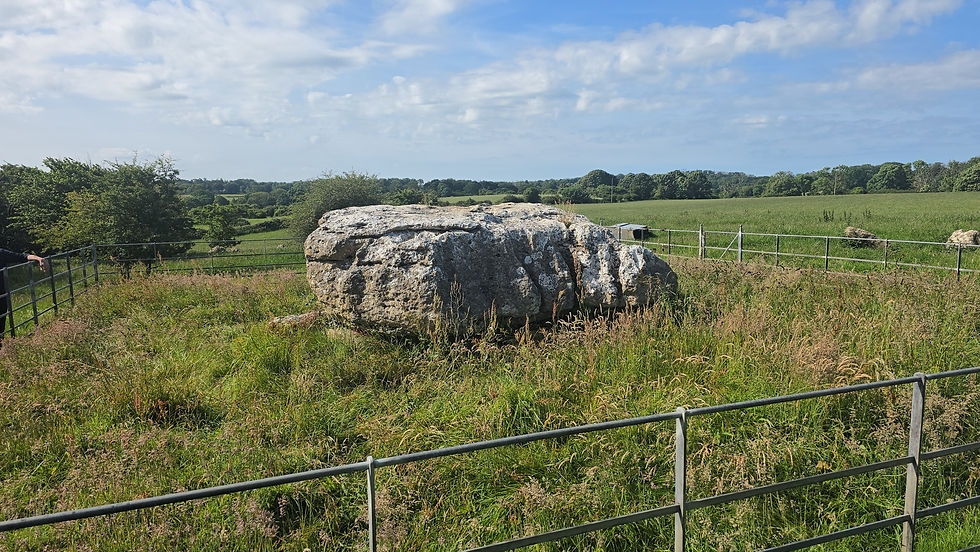
The monument is immediately impressive, but not in the manner of something designed to dominate a distant horizon. It imposes itself at close quarters. Trees now block the coastal view beyond, while behind the chamber shallow hills and scattered copses roll away into the distance. My first approach was almost head-on, which initially flattened the capstone into a broad, low mass. Walking around it changed everything. The stone thickened, gathered bulk and gradually revealed its full squat, rocky presence. What had first appeared almost two-dimensional became something heavy, irregular and emphatically three-dimensional.

Lligwy is old.
Neolithic certainly, although its precise construction date has not yet been securely established. But the finds here show she was used over a considerable period of time. The monument is dominated by the single enormous limestone capstone. Early nineteenth-century measurements put it at roughly six yards long and five and a half yards wide, with its thickness later corrected to about three feet six inches. Modern estimates put its weight at around 25 tons.
Those figures are easier to understand beside the stone than on paper. It is nearly eighteen feet long and sixteen feet across, roughly the length of three people lying head to foot, and in places thicker than the height of a small child. Yet this immense mass of limestone has been lifted clear of the earth to head height so that people can enter the space beneath it.
That is the first extraordinary fact about Lligwy.
The second is that, according to archaeologists Vicki Cummings and Colin Richards, the stone may originally have lain in the very place occupied by the chamber today.
Their reconstruction presents the subterranean chamber as having been created by quarrying and elevating a 25-ton limestone slab, an example of what they describe as in situ dolmen construction.
If correct, its implications are considerable, and it is the reconstruction that has come to make most sense of Lligwy for me. The builders did not necessarily decide to construct a tomb and then search for an enormous stone with which to roof it. They may instead have encountered the stone first, recognised its potential for transformation, and later released it from the surrounding limestone, raised it, and created an accessible place beneath.
The tomb is the place where the stone used to lie.
This changes how we meet the monument. If correct, we are not entering a chamber built beneath a roof; we are entering the stone’s former bed.
That simple idea became the key to Lligwy for me.

Lligwy Neolithic Burial Chamber: Raising the Stone, Opening the Ground
At Lligwy, all the visible stones of the monument are limestone, and the enormous capstone rests today on only three of the eight stones forming the sides of the chamber.
The archaeology adds an important detail. The chamber is not merely an above-ground box beneath this great roof. Its floor was hollowed down into the earth. Neil Baynes, who excavated Lligwy in 1908, dug around four feet below the capstone before reaching the original undisturbed clay, and the sequence of deposits he encountered is fascinating, as we shall see. The recognised entrance lies to the east, and entering requires a small descent into the chamber.
A possible southern entrance has also been proposed, although its existence remains unproven. As we shall see, however, the possibility invites an intriguing reading of the monument.
The Cummings and Richards reconstruction inverts the usual conception of a dolmen's biography.
A slab of limestone lay within the landscape. If their reconstruction is correct, at some point it was recognised as something that could be transformed. People released it, raised it and supported it while opening the ground beneath. Something that had been horizontal and embedded became elevated, while the place it had occupied became accessible to human bodies. This act of raising, possibly for display as well as function, is something Cummings and Richards take seriously, as do I. See my essay on Devil's Den.
We understandably marvel at the engineering involved in raising so much stone towards the sky. How could such an enormous weight be lifted? How many people were involved? What combination of levers, packing stones and temporary supports allowed the slab to rise without crashing back to earth?
Yet concentrating only on what moved upwards misses the stranger transformation taking place below. The ground itself was changed. The great slab was raised and the place it had occupied transformed into a liminal interior beneath its former occupant. What had once been inaccessible beneath the stone could now be entered by the human body.
Yet the stone had not departed. Its immense weight remained immediately overhead. Inside Lligwy that weight is difficult to forget. There is a bone-crushing mass of limestone only a few feet above your back and head, and you are occupying the very place that mass once filled. This is a formerly occupied place, and some part of you remains conscious that it could be occupied again.
That possibility adds tension to the encounter. The stone has been raised sufficiently to admit the human body, but never sufficiently for its weight to cease mattering.
The stone had been raised, but its presence had become more powerful beneath it.

The Lligwy We See Today
There is an important complication before going any further. The Lligwy Burial Chamber we visit today is not precisely the monument Neolithic people encountered.
Lligwy has, in fact, seen remarkably little archaeological excavation. The major investigation was undertaken in 1908 by Neil Baynes, who excavated the interior of the chamber and also investigated immediately outside it. His work recovered the fragmented remains of at least thirty people, adults and children, together with animal bone, pottery, flint and the extraordinary sequence of deposits we shall come to shortly.
Baynes also physically changed the appearance of the monument. Early illustrations and photographs show earth and stone built up around parts of the structure, probably remnants of a mound or other material surrounding the chamber. Before beginning his excavation, Baynes removed earth and stones from around the monument, taking the surface down to, and in places below, the level of the surrounding field.
The exposed table-like dolmen that now stands neatly upon grass is therefore partly a product of twentieth-century excavation and presentation.
Then, for more than a century, there was no further archaeological excavation at Lligwy.
That changed almost by accident in 2022, when a visitor noticed a human tooth lying in a molehill within the fenced enclosure, a short distance north of the chamber. The discovery was reported to Gwynedd Archaeological Trust, and archaeologist Jane Kenney subsequently visited the site, recovering the tooth together with two split flint pebbles from the molehills around the monument.
The obvious concern was that the moles were disturbing surviving archaeological deposits containing human remains.
Cadw therefore funded Gwynedd Archaeological Trust to undertake a small evaluation immediately north of the chamber in February 2023. This was not another wholesale excavation of Lligwy. A trench only about six and a half feet square was opened to discover what the moles were disturbing, whether archaeological deposits and further human remains survived outside the chamber, and what this might mean for the future management of the monument.
What that little trench revealed considerably complicated the story left by Baynes, as we shall soon see.
Baynes’s clearance matters when considering the entrance. We know that the recognised entrance was eastern, and we know that entering the chamber involved descending below the surrounding surface. We should not, however, assume that every inch of the opening through which we squeeze today reproduces its exact Neolithic configuration. Stones have shifted and the surrounding ground has been stripped away.
With that qualification made, the surviving architecture still has an extraordinary effect on the body.
Beneath the Leviathan

You do not walk casually into Lligwy.
I had to stoop deeply and crawl beneath the capstone. The important observation is not that every Neolithic visitor necessarily moved exactly as I did, but that this is a low and physically constraining space.
There is also another stone to negotiate.
Immediately inside the eastern entrance, on the right, is a substantial horizontal slab that I have been calling the shelf. The name is purely descriptive as according to THE EXCAVATION OF LLIGWY CROMLECH, IN THE COUNTY OF ANGLESEY. By E. NEIL BAYNES, it is a supporting slab and part of the structure. But its position is peculiar. Part of it projects into the entrance opening. Baynes also argued that a stone south of the entrance could be the remains of a longer passage to the entance, so the entrance to the monument as it survives today may have been even more restricted. As it is, I either have to constrain myself towards the left to get past it or partly slither across the shelf's edge, but this may have been different in the Neolithic.
That said, the slab at the meoment affects the bodies entrance before the chamber has properly been entered.
Once through, the slab lies immediately to your right. Faced with an orthostat directly ahead, my natural reaction was to turn around towards it.
This is precisely the kind of experience that an excavation plan struggles to communicate. The slab is not simply an object somewhere within a chamber. It participates in entry and draws your attention once in. The surviving architecture requires a sequence of bodily adjustments. You stoop, negotiate the obstruction, descend and turn.
Here the monument produces a striking inversion. The stone has been raised from the ground while the person entering beneath it is compelled downwards into the space it vacated.
This is the question I increasingly find myself asking at prehistoric monuments:
At Lligwy the answer is unusually physical.
A Stone for the Body

The horizontal slab becomes more intriguing once you turn towards it because its proportions are distinctly human.
I have lain upon it, and my body fits along it. Yet it is narrow enough that it makes little obvious sense to me as a conventional seat or bench. In bodily terms, it seems far better suited to someone lying down than sitting comfortably.
That does not make it a bier.
There is presently no archaeological evidence demonstrating that a corpse was ever laid upon it. It might be retained bedrock, part of the process by which the chamber was excavated, a constructional feature, a working surface or something else entirely. Before any stronger argument could be made, the slab needs systematic recording. Its exact dimensions, height above the chamber floor, relationship with the entrance and capstone, and whether it is a separate slab or part of the underlying limestone all need establishing.
Nevertheless, context matters.
Neolithic chambered tombs were not necessarily places in which an intact corpse was carried inside, laid down and left undisturbed. Mortuary treatment could be prolonged and complicated. Bodies might be exposed while soft tissue decayed, bones could become disarticulated, particular elements could be selected or moved, and human remains might pass through several stages before reaching what became their archaeological resting place. We should be wary of imposing a single universal sequence on Neolithic burial, but death could be a process rather than a moment of closure.
Lligwy itself makes that especially relevant. The human remains recovered from the monument are highly fragmented, while the recent excavation outside the chamber produced loose teeth, foot bones and other small human fragments. The excavator explicitly raises excarnation, the exposure and decomposition of bodies before their bones were finally deposited, as one possible explanation, and even allows that such activity may have taken place around the tomb during its period of use.
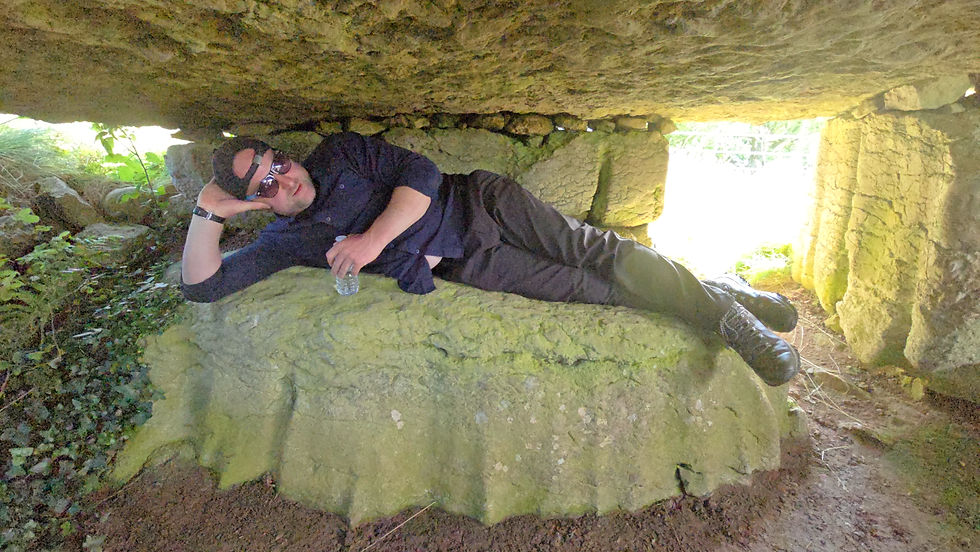
Seen in that context, a human-sized horizontal slab beside the entrance becomes harder simply to ignore. It need not have been a permanent resting place for the dead. But a surface on which a body could lie might have participated in one stage of a longer mortuary process: presentation, preparation, temporary placement, manipulation of remains, or some ceremony associated with the passage between living body and deposited bone.
That remains speculation, but it is archaeologically informed speculation.
Within a monument so heavily involved with the dead, the possibility that a human-sized horizontal stone played some role in the treatment, temporary placement or presentation of bodies is a legitimate question.
The architecture leaves us with an intriguing bodily contrast. The living enter constrained beneath the raised capstone and turn towards a stone upon which another human body could lie horizontally.
For the moment, that is as far as the evidence allows us to go.
Sleeping in the Capstone's Bed

Calling Lligwy a burial chamber is correct, but the term can produce an image much tidier than the archaeology.
Baynes recovered the remains of at least thirty individuals and the bones were highly fragmentary. At least twelve jaws were present, together with numerous teeth and small skeletal elements. There is no indication that Baynes recognised burnt human bone in his assemblage, although the 2023 excavation did recover a small quantity of burnt human remains.
The interior bed itself was stratified. Baynes recorded red clay soil above a layer dominated by limpet shells. Beneath this lay dark stony soil containing human and animal bones, pottery and flint. This sealed a pavement of flat stones, below which was another dark, find-rich layer. At the bottom, immediately above the base of the chamber, was wet, sticky soil containing mussel shells.
This does not resemble a monument filled during a single burial event and then forgotten.
A surface was laid over earlier deposits and further material accumulated above it. Pottery indicates that Lligwy continued to attract activity through later phases of the Neolithic and beyond. The stratigraphy shows that the space beneath the stone was not created for one mortuary event. It was returned to, altered and used again.
People came back.
And the history of the dead extended beyond the chamber itself.
Beyond the Chamber
The 2023 evaluation considerably complicated the picture at Lligwy.
Human bone and teeth were present in the topsoil, apparently disturbed upwards by mole activity, but beneath this survived archaeological deposits containing further human remains.
Most intriguing was a find-rich layer sealed beneath later material. Although only a small part of it was excavated, it contained a substantial quantity of fragmented human bone and teeth, including a small proportion that had been burnt.
Alongside them were animal bone, worked chert and flint, a finely made leaf-shaped arrowhead, Neolithic pottery, marine shells and water-worn pebbles.
Its relationship with the monument is not yet securely understood. It may relate to activity associated with the construction or use of the tomb, possibly including mortuary activity around its exterior, but the excavation was deliberately small and the 2023 report remains preliminary.
The evidence therefore raises the possibility that mortuary activity was not confined to the chamber. The monument’s story extends beyond its stones.
Baynes had already encountered human teeth and bone immediately north of the monument in 1908. More than a century later, the same side of the tomb again produced fragmented human remains.
The boundary between the dead inside Lligwy and activity outside it is therefore less clear than the surviving stone chamber might suggest.
Bringing the Sea to Lligwy

The marine shells initially seemed to me an interesting detail in the archaeology of Lligwy.
The more closely I looked at them, the less incidental they became.
Baynes had already found marine shell inside the burial chamber. Limpets formed a distinct layer higher in the sequence, while mussels occurred in the lowest deposit.
The 2023 excavation recovered around 140 further shells, almost all marine. Winkles and small whelks were particularly common, together with numerous limpets. Mussel survived less well, but fragments appeared during wet sieving, and Kenney suggests that some of the tiny shell fragments visible throughout context 007 were probably degraded mussel. The excavation report is explicit that the marine shells must have been carried to the site.
The layer designated as Context 007 is particularly interesting because shell occurs amongst human bone and teeth rather than within a single isolated pocket. The finds catalogue records marine shells alongside bone fragments, human teeth and rounded stones, while the bulk sample produced further marine shell, predominantly human bone and teeth, Early Neolithic pottery and three water-worn pebbles.
A larger rounded cobble was also found resting on the bottom of another cut feature. Kenney noted that it appeared almost as though it had been placed there. Some water-worn stones could derive from glacial deposits, but several were considered likely to be beach pebbles.
The obvious explanation for shells is food. Neolithic people ate shellfish, and a limpet does not become a sacred object simply because an archaeologist finds it in a tomb.
But the Lligwy evidence is not confined to the debris of one meal.
Marine material appears at different levels inside the chamber and occurs again outside it. It is associated with deposits containing human remains and with stones apparently carried from water-worn environments.
Repetition changes the question.
Why was material from the shore repeatedly entering the place beneath the raised stone?
Marine Shells in Neolithic Tombs
Lligwy is not unique.
That matters because comparison allows us to move beyond the two easiest explanations, either that the shells were ordinary rubbish or that they must have been sacred offerings.

Antony Pollard's 1994 study of marine exploitation in prehistoric Scotland drew attention to marine shells appearing in archaeological contexts that cannot comfortably be described as conventional shell middens. Chambered tombs were among them.
At Crarae in Argyll, substantial concentrations of marine shell occurred in relation to chamber and forecourt deposits. At Cairnholy, shells were incorporated into the blocking of the tomb entrance. At Tulloch an t-Sionnaich in Caithness, marine material was carried a considerable distance inland and deposited through chamber fills containing animal and human remains. Comparable evidence from Ireland shows that the phenomenon was not restricted to Scotland. Closer still is Barclodiad y Gawres on Anglesey, where marine material also entered the ritual deposits of a Neolithic chambered monument. I have explored the significance of that material in a separate essay, Temple of the Sea.
These monuments need not share a single explanation. The evidence does not demonstrate a Neolithic shell cult or a common theology stretching around the Irish Sea and Atlantic coast.
What it demonstrates is narrower and more useful.
The deliberate movement of marine material into Neolithic chambered monuments is a recurrent archaeological phenomenon.
Pollard's broader argument is particularly useful here. Material can possess a history before reaching its final archaeological context. Shellfish were gathered, transported, perhaps cooked and eaten, while their shells might subsequently be collected or redeposited. Human bone, animal remains, pottery, stone, ash and shell could enter monuments after passing through very different sequences of activity.
Their significance need not therefore reside entirely in the intrinsic qualities of individual objects. Their movement and previous associations may also have mattered.
That fits Lligwy particularly well because movement is already central to the monument.
The great limestone slab may hardly have travelled at all.
The shells did.
Raising Stone, Returning Stone

There is another possibility here, much more speculative but difficult to ignore.
If Cummings and Richards are right, Lligwy began with an extraordinary act of removal. An enormous slab of local limestone was released from the earth and raised above the place it had occupied.
Immediately north of that raised stone, less than a yard beyond the edge of the capstone, the 2023 excavation found something very different. A small rounded, water-worn cobble lay on the flat base of a cut feature, apparently deliberately placed there.
The contrast is striking.
The great stone may scarcely have travelled at all. It belonged to this limestone plateau and was lifted from the ground. The little stone had travelled from somewhere else. If, as its water-worn appearance suggests, it had been brought from the shore, then before human hands ever carried it to Lligwy the sea had already transformed it, rounding and smoothing it through movement and time.
Was something being returned to the earth?
We cannot know. The cut in which the cobble lay has not yet been securely dated, so any relationship with the construction or ritual life of the Neolithic monument remains unproven.
Yet the possibility is intriguing. One immense local stone was taken from the ground and raised into the air. A much smaller stone, transformed by the sea and carried inland, may subsequently have been placed back into the cut earth beside it.
Perhaps the significance lay not simply in stone, but in exchange: stone raised from the land, stone returned from the sea.
Lligwy Neolithic Burial Chamber: The Stone That Changes
There is one further quality of the Lligwy capstone that belongs firmly to field observation rather than established archaeology.
Walking around the monument, I found that the stone does not retain a single visual identity.
From one very particular viewpoint, part of the capstone resolves into what looks to me like a bear-like head. The effect is three-dimensional. What appears as the nose actually lies behind the feature perceived as the eye, but from the right position, perspective collapses that depth and the separate features suddenly assemble themselves into a face.

Move only slightly and the relationship breaks apart.
The animal disappears.
That is considerably more interesting to me than simply claiming that Lligwy possesses a bear-shaped stone. It does not, at least not in any fixed sense. The form exists only through the relationship between the morphology of the stone and the position of the observer.
Arthur’s Quoit and the Bear in the Stone
There is a curious later echo around this particular transformation. Lligwy was once known locally as Coetan Arthur, Arthur’s Quoit, one of many prehistoric monuments in Wales drawn into the gravitational field of Arthurian folklore. The name is almost certainly much younger than the tomb. It tells us about the later imaginative life of the stone, not necessarily about those who raised it. Yet at Lligwy the association acquires an unexpected resonance. The Welsh word arth means bear, and one disputed but serious etymology traces the name Arthur through a Celtic element meaning bear. From one precise position, the capstone itself can resolve into something resembling a bear’s head. Move slightly and it disappears. None of this proves that the medieval name preserved a Neolithic image, or even that those who called it Arthur’s Quoit saw the same animal. The connection may be entirely accidental. But monuments accumulate meanings because people continue to look at them. At Lligwy, Arthur, bear and stone now occupy the same uncertain imaginative ground.
The significance therefore lies less in the animal itself than in the stone’s perceptual instability, its capacity to change as the observer moves. At certain positions recognisable forms emerge; a few steps later they dissolve again.
Pareidolia is obviously part of this phenomenon, but that need not make the observation archaeologically irrelevant. Some stones are more susceptible to such readings than others because of their irregular surfaces, projections, hollows and changing profiles. The open question is whether such visual instability could itself have contributed to the recognition and selection of particular stones.
If the capstone was raised substantially in situ, its builders would have known these natural surfaces before, during and after its transformation. Raising the stone would then have transformed not only its physical relationship with the ground, but also the ways in which it could be seen.
What can be observed is simpler.
At Lligwy, movement does not merely change what can be seen around the monument. It changes the stone itself.
Between Earth and Stone: Putting the Body Back into Lligwy
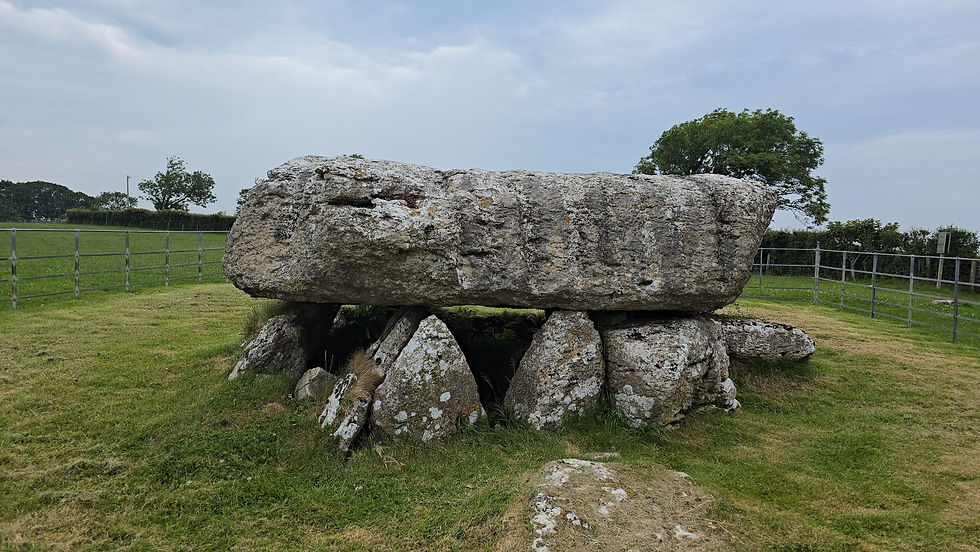
Lligwy Burial Chamber is easily summarised archaeologically. It is a Neolithic chambered tomb on Anglesey, dominated by an enormous limestone capstone and containing the fragmented remains of at least thirty people.
All of that is true, but it does not quite capture what makes the place extraordinary.
The Cummings and Richards reconstruction offers another way of seeing it. Lligwy may have begun not with an empty chamber waiting to be roofed, but with the stone itself, already lying within the limestone landscape. Raising it transformed more than its position. A great horizontal mass embedded in the earth became an elevated presence, while the place it had occupied became accessible for the first time.
A human body could now enter the capstone’s former bed.
From outside, the achievement is one of raising and display. From beneath, the relationship is reversed. The visitor stoops and descends into the narrow interval between earth and twenty-five tons of limestone. The stone has risen, but the body is forced downwards. Its former resting place becomes somewhere the living can enter and the dead can inhabit. The weight has not disappeared. From beneath, its presence has become more powerful.
Nor was this newly created place isolated from the world beyond it. Human remains occur both within and outside the chamber.
Marine shells repeatedly entered Lligwy, carried at least a mile inland from the coast. Water-worn stones arrived too, objects that had already undergone another transformation before human hands selected them. They had been rolled, rounded and smoothed before they were transported across the land.
One of those small sea-transformed stones may even have been deliberately placed back into the ground immediately beside the monument. Its date and significance remain uncertain, and it would be wrong to force the evidence further than it will go. Yet the possible inversion is difficult to ignore. An immense local stone was taken from the earth and raised. A much smaller stone, transformed by the sea and carried inland, may have been returned to it.
We cannot recover the beliefs that connected these acts, or even know that the people who performed them understood them as connected at all. Lligwy does not surrender a lost Neolithic theology simply because we enter the chamber and pay attention to what happens there.
But putting the body back into the archaeology changes what we notice.
Stone rises while the human descends. The living enter the place the stone once occupied. The dead come to rest within it. Materials from the sea cross the land and enter the monument. Earth, stone, sea and body are repeatedly brought into new relationships.
Perhaps that is as close as we can presently come to the peculiar power of Lligwy. It was not simply a container for the dead beneath an impressive roof. Raising the capstone transformed the stone, transformed the ground beneath it, and transformed what a human body could do there.
Between earth, stone and sea, they drew the human body into a new relationship with their universe.
Dr Alexander Peach
Leicestershire 2026
Stone Temple Gardening is built through fieldwork: walking, filming, photographing and testing prehistoric landscapes on the ground. If this work interests you, you can support future site visits and research here.


Comments