Robin Hood’s Stride, Peak District: A Prehistoric Ridge from Stanton Moor to the Grey Ladies

The land doesn’t just lie there between Stanton Moor and the Grey Ladies stone circle.
It pulls you.
After a morning among the stone circles and cup-marked rocks of Stanton Moor, my wife and I stepped onto the ridge that connects the two sites and immediately felt it. The ground itself was directing our steps, as if the prehistoric people who first walked here had left the path in the bones of the hill.


The Cork Stone marks the threshold onto the ridge, a natural formation that fixes attention first Cork Stone Face The Cork Stone
It began at the eerie, face-marked Cork Stone, dropped through a green tunnel of birch, oak, rowan, hazel and ash where deer ghosted between the trees, then carried us past the Rocking Stone and the pretty mining village of Birchover flickering between branches. By the time we reached the Druid Inn we were ready for the dark local beer and the even darker local tales.
Suitably fortified, we stepped back onto the footpath that leads straight to the looming gritstone towers of Rowtor Rocks and the unmistakable silhouette that dominates the entire horizon.
Robin Hood’s Stride was waiting.
Rowtor Rocks: Rock Art and Movement
Leaving the Druid Inn, the ridge doesn’t simply carry on.
It stops you.
The ground suddenly gathers into a wild gritstone labyrinth of Rowtor Rocks. What had been smooth forward momentum fractures into a jumble of outcrops, passages, edges and hidden openings. The walk shifts from straight-line progress to something far more hypnotic.
Since the Cork Stone, woodland had boxed us in. Here the trees fall back. Sweeping views open north to Stanton Moor, the cup-marked Andle Stone standing clear in the distance. The ridge that had pulled us forward now breaks apart. Paths split, double back, loop. The land no longer pushes. It complicates, invites, holds.
And everywhere, the rocks are alive with carvings.

Cup marks, rings, a quartered circle with radiating lines, the faint trace of a serpent. Steps cut deep into stone, chambers hollowed out, seats and basins shaped by human hands. The line between raw gritstone, Bronze Age art and later tinkering blurs completely. These markings link Rowtor directly to the stone circles we had just left on Stanton Moor. These surfaces seem to have demanded attention for thousands of years.

The rock itself feels restless with movement. A famous rocking stone once balanced here so delicately a hand could set it swaying until it was toppled in the late 1700s. Others nearby still quiver slightly underfoot. Even the name “Rowtor” remembers the rocking, the restless energy locked inside the stone.

In the late 1600s and early 1700s, barrister Thomas Eyre inherited the land and was drawn back to it repeatedly. He carved seats, passages, basins, even what looks like a private altar and font. This wasn’t casual meddling. It was a deep, sustained conversation with a place already recognised as sacred.
Later came the Druidic layer, 18th century meeting and ceremonies tied to the nearby inn and the Ancient Order of Druids. Another chapter in the same long story.
What you feel here is continuity across millennia. Different people, different beliefs, all drawn back to the exact same rocks. Meaning doesn’t get imposed on empty land. It accumulates through repeated return.
Rowtor Rocks is the pivot.
The ridge no longer simply carries you forward. It holds you. Linear progress gives way to slow, circling encounter. Your attention turns inward and circulates among the stones, the carvings, the views toward Stanton Moor.
Only then does the path release you again, toward Cratcliffe Rocks and its hidden Hermit’s Cave, though modern walls now break what was once an unbroken line of ancient movement. The path runs below to the road where you cross and ascend the ridge again.
passing a suspiciously monolithic rock hiding as a gatepost you reach the top and scramble up to the next point of encounter.
Cratcliffe Rocks and Hermit’s Cave
At Cratcliffe Rocks the relationship between movement and place deepens even further.
The ridge does not just carry you onward.
It invites you to stop.
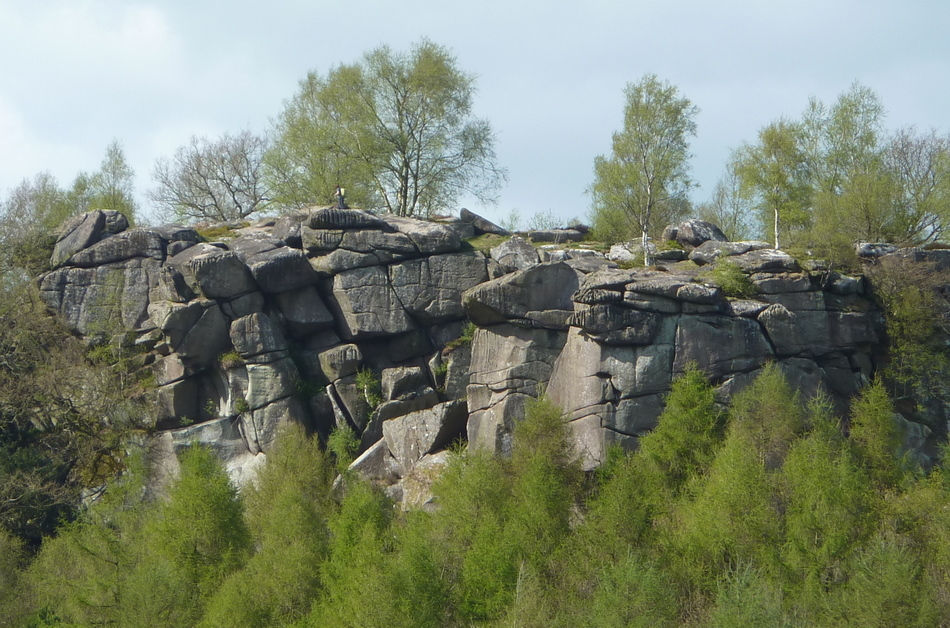
Beneath the outcrop lies a rock shelter that later became a hermitage. A small built structure set directly into the stone. Though the surviving remains are medieval, the choice of location is far from random. Positioned on the ridge with commanding views along the ancient line of travel, it marks a point of deliberate pause.
Here shelter, prominence and visibility coincide perfectly. The ridge is no longer something you simply pass through. It becomes a place you pause within.
The line of movement then dips and rises again across the fields. It is briefly broken by the modern road before it returns to the ridge. A curious gatepost stands with the quiet stance of an ancient stone and marks the re-ascent toward Wastcliff Rock Shelter, where the ground gathers once more beneath the outcrop.
Wastcliff Rock Shelter and Pareidolia
At Wastcliff Rock Shelter the ridge pauses again.
Faces in Stone Bird Like face The rock shelter
This shelter is shallower and less modified than the hermitage at Cratcliffe. It is only a simple overhang where the outcrop begins to resolve into the twin pinnacles of Robin Hood’s Stride ahead.
Here, just as at Rowtor Rocks, the Cork Stone and the Andle Stone, the weathered gritstone forms clear pareidolic faces. Shapes that the human eye reads instantly as watchful or expressive.
This is not random. It is how we are made to see. It is a deep neurological instinct. An ancient survival mechanism that makes us detect agency and presence in the landscape.
For prehistoric travellers moving along this ridge those animistic qualities in the rock would have charged the place with life. They would have invited pause and return long before any carving or modification ever took place.
Moving on, Robin Hood’s Stride resolves to dominate the western view. Its twin pinnacles rise abruptly above the slope. They break through the line of the land with a force that is impossible to ignore.
Aubrey Burl once compared it to a great hippopotamus with its head and ears lifted against the skyline. The image only gestures toward the truth. The rock formation carries a weight that exceeds any description. It anchors the horizon and draws everything toward it.
Down on the moor the Grey Ladies stone circle stands clearly visible. The stones, however, now seem diminished. They do not compete with the Stride.
They face it.
Their presence here begins to make sense not as an isolated act of construction but as a response. The monument below does not dominate the space. It acknowledges the Stride and brings the long marked journey from Stanton Moor to its natural end.
Robin Hood’s Stride, Peak District: A Geological Transition
Robin Hood’s Stride sits at a point of transition.

Here the softer limestone of the White Peak gives way to the harder gritstone of the Dark Peak. The change is not abstract. You feel it underfoot in the shift from pale worn ground to darker fractured stone. The land lifts and breaks. Water drains differently. The surface hardens.
This matters.
What you encounter here is not simply a striking outcrop. It is a boundary made visible. The gritstone asserts itself. The piled blocks of the Stride fix that shift in place so it can be seen, approached and recognised.
The same divide appears in the monuments themselves. On the open limestone plateau of the White Peak the great henges and barrows command wide visible ground. Here on the gritstone edge the pattern changes. Monuments become smaller, more dispersed and more closely tied to the rock itself. Surfaces are marked. Outcrops are returned to. Routes are followed rather than dominated.
At Robin Hood’s Stride that wider pattern resolves into a single point of encounter beneath your feet. The boundary is not inferred. It is present. Thresholds draw attention. They mark where one mode of movement becomes another. Where the ground alters and perception sharpens.
Here, as along the ridge behind, significance does not begin with construction. It begins with encounter. It begins with the recognition of a place already set apart by the land itself.
Robin Hood’s Stride: Form, Marking and the Watching Rock
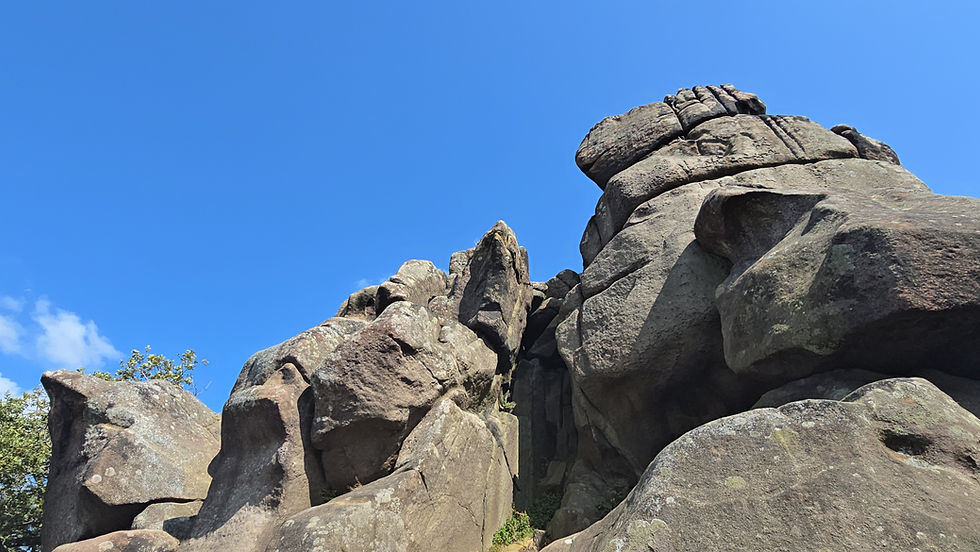
Up close the Stride is not simply two pinnacles rising from the slope. It is a mass of fractured gritstone broken into ledges, faces and narrow passages. The twin towers pull the eye from a distance. At ground level the rock resolves into surfaces that invite inspection. Edges catch the light. Shadows deepen every hollow and seam. The formation feels varied, textured and visually alive.
There is no clear evidence of extensive prehistoric carving directly on the Stride itself. Yet it sits within a landscape where marking is widespread. Cup-marked stones lie nearby. The worked surfaces of Rowtor and the Andle Stone are within direct sight. The absence of heavy carving does not suggest absence of significance. The rock does not need to be altered to be recognised. Its form already commands attention.
Certain faces within the stone resolve into something more than fractured geology. Profiles emerge in the shifting light. Eye-like hollows. Brow lines. Suggestions of expression. These are not carvings, yet they are not neutral. The human tendency to recognise faces in the landscape is immediate and difficult to suppress.

Along this ridge, from the Cork Stone to Rowtor and here at the Stride, the rock repeatedly offers forms that appear animated, attentive or watchful. Once seen they are difficult to unsee. They fix attention. They invite return.
Robin Hood’s Stride and the Grey Ladies Alignment
Moon Rise at Robin Hood's Stride Moon Over Robin hood's Stride Ridge Path of the Moon at Robin Hodd's Stride
From this position the relationship with the Grey Ladies becomes clear. The circle sits below, oriented toward the Stride. From within the circle the horizon is gathered and held by the rising mass of the tor. It is here that the moon, at its southern extremes, moves along the skyline formed by the Stride. Not as a single point of alignment but as a path traced across the rock. The effect is not one of precision but of framing.

This has often been treated as a precise lunar alignment, but the evidence suggests something broader. The Moon does not target a single point. It moves along the ridge. What is visible is not a fixed alignment but a repeated interaction between lunar movement and the form of the land.
From the circle, the Moon is seen to descend into the elevated mass of the Stride rather than setting on a distant horizon. Its light is drawn down into the rock until it disappears from view. The effect is not occasional or rare. It recurs across the cycle.
What is marked here is not a point in the sky, but a condition of the landscape. The horizon gathers the movement. The monument responds to it.
The Stride provides the horizon against which movement in the sky becomes visible. The circle does not impose this relationship. It responds to it. What is marked in stone is a pre-existing condition of the land.
Seen from the ridge that relationship reverses. The circle diminishes while the Stride holds the horizon. One gathers space. The other defines it. More here.
Rock Art Along the Ridge: Marking Movement Between Stanton Moor and Robin Hood’s Stride
Across the ridge, the markings are never confined to a single place.
They appear quietly, worked into the gritstone surfaces that line the entire route. Cup marks, rings and simple grooves show up on outcrops and boulders from Harthill Moor through Rowtor and beyond. Some are sharp and unmistakable. Others are worn almost to nothing, only revealing themselves under the right angle of light.

These markings do not redirect the walk.
They sit inside it.
They appear on the same elevated ground that already guides your steps. On surfaces you meet naturally along the line of travel. There is no sense of isolation. Each panel belongs to a wider pattern of engagement with the ridge itself. What is marked is not a destination. It is the route.
This distribution matters.
It tells us that attention was never fixed at one spot. Instead it stretched across the whole landscape through quiet repetition. Surfaces that drew the eye were returned to, touched and worked. The act of marking stabilised certain moments within the flow of movement without ever stopping it completely.
At Rowtor Rocks that process intensifies. Elsewhere it remains lighter and more dispersed. But the logic stays the same.
The ridge is not simply traversed.
It is engaged with, again and again, along its full length.
What survives is not one grand act of marking. It is an accumulation. A landscape in which recognition and return have left their trace not in a single place but across many.

From Stanton Moor to Robin Hood’s Stride: A Landscape of Structured Encounter
Seen along the line of movement, everything resolves into a single system.
Not a collection of isolated monuments. A landscape held together by movement, recognition and return.
At Stanton Moor attention disperses across the open plateau. Cairns, circles and marked stones gather the eye in every direction. At the southern edge the Cork Stone stands as the threshold. Movement gathers and is drawn onto the ridge, where the land itself takes over. The route is not imposed. It is given by the ground.
Along the ridge the markings travel with you. At Rowtor Rocks the flow slows, fragments and turns inward. What was a straight line becomes a cluster of encounters. Attention is held.
Beyond, the ridge continues through Cratcliffe and Wastcliffe. Shelter, enclosure and watchful rock deepen the sequence. At its western end Robin Hood’s Stride rises as the dominant horizon. The Grey Ladies circle below sits in quiet response to it, its stones facing the tor that already commanded the view.
The same pattern repeats across the entire system. Natural features first fix attention. Movement follows. Marking stabilises what the land has already offered. Monuments then formalise the key moments, not by forcing order on the landscape but by honouring what was already there.
This is not monumentality imposed on the land.
It is monumentality emerging from it.
The ridge does not merely connect sites. It organises them. From Stanton Moor to Robin Hood’s Stride you do not walk a path between monuments. You walk through a landscape in which movement, perception and marking have always been inseparable.
The monuments do not define the system.
They reveal it.
Dr Alexander Peach
April, 2026
Stone Temple Gardening is built through fieldwork: walking, filming, photographing and testing prehistoric landscapes on the ground. If this work interests you, you can support future site visits and research here.
Bibliography.
Barnatt, J. (1990) Prehistoric Derbyshire. Sheffield: Sheffield Academic Press.
Barnatt, J. (2016) The Peak District: Landscapes Through Time. Macclesfield: Windgather Press.
Burl, A. (2000) A Guide to the Stone Circles of Britain, Ireland and Brittany. New Haven: Yale University Press.
Bradley, R. (1998) The Significance of Monuments: On the Shaping of Human Experience in Neolithic and Bronze Age Europe. London: Routledge.
Bradley, R. (2019) Megalithic Societies: Old Questions, New Narratives. Oxford: Archaeopress.
Tilley, C. (1994) A Phenomenology of Landscape: Places, Paths and Monuments. Oxford: Berg.
Ruggles, C. (1999) Astronomy in Prehistoric Britain and Ireland. New Haven: Yale University Press.
Guilbert, G. and Garton, D. (2010) Stanton Moor: An Archaeological Survey. Derby: Derbyshire Archaeological Society.
Parker Heath, I., Cheetham, P. and Shaw, L. (2013) Geophysical Survey Report, Arbor Low Environs Project: Gib Hill Barrow, Derbyshire. English Heritage.
Stone Temple Gardening, Stanton Moor, Robin Hood’s Stride, Grey Ladies stone circle, Nine Stones Close, Derbyshire archaeology, Peak District prehistory, prehistoric landscapes, megalithic landscapes, stone circles UK, rock art, cup marks, Bronze Age Britain, prehistoric routes, ancient pathways, archaeoastronomy, lunar movement, phenomenology of landscape


Comments