The Dolmen of Llech-y-Drybedd: Reading Stone, Serpent, and Sky in the Preseli Landscape.
Updated: May 5

Welcome back to Stone Temple Gardening, where we dig into the rich earth of the past to cultivate new ways of seeing prehistory through landscape and stone, grounding interpretation in place, movement, and material presence.
Today we continue our journey through the sacred Preseli landscape, turning our attention to the ancient dolmen of Llech-y-Drybedd. Set apart yet deeply embedded in its surroundings, this monument invites a slower reading of place, one attentive to geology, movement, and memory as much as form.
This post sits within a connected sequence of field visits and reflections. If you have not yet read the earlier pieces on Gors Fawr stone circle and Pentre Ifan, you may wish to begin there, as each site speaks quietly to the next, forming a coherent ceremonial landscape rather than isolated monuments.

Llech-y-Drybedd — The Giant’s Throw
After the dragon-faced stone at Pentre Ifan revealed itself to us the day before, we woke to a sky shaking off its restlessness and turned west again, following narrow lanes that rose and fell like breaths between banks of fern and foxglove. The night’s rain had scoured the air clean. Light pooled in the puddles like fragments of a broken sky, and the scent of peat moved along the wind as if the ground itself were lifting something half-remembered to the surface.

We left the car in Moylgrove, a quiet village folded into the Nevern valley at its meeting two watercourses, the Awen and the river Ceibwr. Awen is from the old Welsh word for inspiration, a stream carrying its meaning as naturally as its water. The wooded gorge leading to Ceibwr Bay begins just beyond the houses, a short walk that feels longer than it is, as if distance bends slightly under the weight of its own stories. Ceibwr bay, partly protected as a Site of Special Scientific Interest, is cherished as the village’s small beach, a place where geology and weather have conspired for millennia to carve caves, stacks, gullies, and sudden narrow tunnels into the cliffside.

We followed the path down the tumbling Ceibwr river and valley, the arched canopy filtering the light into shifting shafts of green. Towards the bottom the trees thinned as the coastline opened before us in a sweep of raw sea, stone and sand. The cliffs here run north–south in great heaving folds, rising from the earth with the slow authority of something that has always been here. They look west across open water towards Ireland, an old seaway where weather builds its own architecture. Standing on their edges, the world seemed to widen. Waves broke against the rock below, and as the haze briefly thinned, the distant outline of Ireland emerged, like an ancient shore returning from the sea’s long memory.

We continued along the coastal path, which twisted and writhed, rising and dipping with the grain of the land. In places it steepened enough to tighten the body and test our resolve, though the ground held firm beneath our feet. After a few magnificent miles we left the cliff line and turned inland, climbing through woodland and open pasture, where the wind moved through grass and hedge, carrying the quiet breath of the Preseli.

We soon reached the narrow road that climbs toward the tomb. Here the hedgerows drew close, the way tightening into a green corridor that guided us uphill. The fields fell away behind us; ahead, the slope gathered height and we began to puff and pant. With brows damp and legs fully stretched, we paused at the final stile to recover our breath and take in the sweep of the land. Beyond the stile, a short walk through long grass brought the monument into full view.

Llech-y-Drybedd stood alone on the crest of the ridge, the land falling away to east and west. The rugged capstone is supported by three uprights, its slight forward pitch giving the whole structure a sense of poised intention.

The name Llech-y-Drybedd translates roughly as the “Tripod Stone”. A spare and practical description, though one that still implies poise and equilibrium, and perhaps tension too: three points anchoring an act of balance against gravity and time. An alternative reading, “Stone of Three Graves”, carries a more explicitly funerary tone. As with many Welsh monument names, it is difficult to know how much ancient meaning survives in later tradition and how much reflects medieval or post-medieval interpretation layered onto an already ancient structure.
Seen up close, the triangular form pulls the gaze upward, while the base spreads outward into the turf like roots. Its siting is deliberate and commanding: the Preseli uplands unfold in one direction, the coast in the other, binding upland and sea within a single field of presence. The monument has been surveyed and recorded on several occasions, and typological comparison places its construction broadly in the later Neolithic, around c. 2800 BCE. It is not in perfect condition. One of the uprights shows a significant crack, echoed by a fracture in the capstone, reminders that even these enduring structures exist in a state of slow negotiation with weather, gravity, and time.

Reading Place Before Monument
Regular readers will know that I take a phenomenological approach to reading landscape and monument. It is an exercise in attuning the senses to older habits of perception: learning to see the land not as a neutral backdrop, but as something charged with presence. Crucially, it is place that comes first. Certain landscapes exert a force on perception long before stone is shaped or raised, and monuments serve to gather, focus, and formalise that existing power. Both Paul Devereux and I have argued that what might be called natural temples are often recognised and returned to long before they are monumentalised. In this view, monuments do not initiate meaning; they memorialise it, fixing in stone what was already apprehended through landform, horizon, and sky.

Serpent Form and Landscape Perception
I walked slowly around the curious capstone, studying its weight and angles from every vantage. As at Pentre Ifan, certain viewpoints hinted at something faintly reptilian: a short-jawed serpent lifting its head, its form held at the threshold between stillness and intention. Earlier, while walking the cliffs below, I had noticed the same quality in their fractured faces. With time, the broken seams and stacked blocks began to organise themselves into suggestive figures — giants at rest, or imagined creatures lowering their heads to drink from the green waters of the Irish Sea.

Read in this way, the impulse sensed at Pentre Ifan reappeared here not as symbol or story, but as a recurring quality of form. It seemed to run across ridge, cliff, and capstone alike, as though the wider landscape retained a memory of certain shapes that monuments merely sharpen and hold. In Wales, the dragon is not simply a heraldic emblem applied after the fact, but a figure rooted in long encounter with place — an imaginative response to land that coils, rises, and asserts itself through horizon and stone.

Archaeology and Imaginative Power
Archaeology is rightly concerned with evidence, chronology, and material proof. What it often struggles to account for is the imaginative power of place itself: the capacity of certain landscapes to act upon perception before, during, and long after monument-building takes place. By focusing so intently on monuments as discrete objects, it can lose sight of the earth, sky, and horizon they occupy, treating these as background rather than as active participants. Yet it is precisely these elements — slope and skyline, distant peaks, solar paths, lines of sight — that shape how places are experienced, remembered, and returned to.
The impulse to speculate, to mythologise, or to sense presence is not a failure of reason. It is a real response elicited by place and intensified by monument. Whatever meanings such landscapes once held, their power to act upon the human imagination has not faded. To read sites like Llech-y-Drybedd fully, the land itself must be read first.

The red dragon of Welsh heraldry imagined as an echo of older earth-bound myth,
where hidden forces beneath the land rise into symbol and story.
Dragon Memory as Landscape Response
The Welsh dragon is most often encountered on flags and heraldry — the scarlet creature of kings and poets — yet its roots lie far deeper than the emblem’s modern surface. In early medieval legend, beneath the fortress of Dinas Emrys, two dragons were said to writhe in an underground lake, one red and one white. (1) When they were unearthed, the red dragon prevailed, foretelling the triumph of the Britons over the invading Saxons. From this image of buried struggle the princes of Gwynedd took their banner, and Cadwaladr’s red dragon became a sign of Welsh sovereignty. Yet the story itself reaches further back still, into an older imagination of the earth as animate: a body charged with hidden motion, pressure, and release. (2}
Across cultures, the dragon or serpent is repeatedly imagined as a creature of the ground, its sinuous movement echoing the rise and fall of ridge and valley. In China, the Dilong — literally the “earth dragon” — governs rivers and soil, stirring the hidden veins of the land. (3) In Greece, the serpent Python, slain by Apollo at Delphi, was said to coil within the womb of Gaia herself. (4) In both East and West, the dragon appears as a mediator between earth and spirit: the pulse beneath mountains, the quickened life within stone.
Snakes are widely recognised as precursors to later mythic dragon imagery and occupy a liminal role. Burrowed within the underworld, gliding across the surface of the middle world, and, in their mythic elaboration, ascending toward the heavens as dragons, they bridge a layered cosmos. Anthropology has long noted that such symbolic structures emerge from sustained, embodied relationships with landscape, carried forward into ritual, story, and monument.

Underworld, Surface, and Sky
Across many prehistoric cosmologies, the world is conceived as a tripartite structure: an upper realm of sky and light, a middle realm of human and animal life, and a lower realm associated with earth, water, and the dead. This three-tiered cosmos is not an abstract scheme imposed upon the world, but a lived ontology arising from embodied movement through landscape.
Building on this, Lewis-Williams and Pearce argue that such vertical cosmologies are grounded in recurrent features of human cognition, particularly altered states accessed in darkness, in caves, or through ritualised engagement with place. Seen in this light, the Neolithic world was not divided but vertically integrated. What occurred in cave or tomb touched the under-realm; what unfolded on ridge or summit approached the sky; and what took place among fields and dwellings belonged to the middle world where humans continually negotiated the two. Within this framework, creatures such as snakes acquire their liminal force — as beings whose movement naturally crosses boundaries between earth, surface, and depth.
The Preseli Landscape as a Living Form
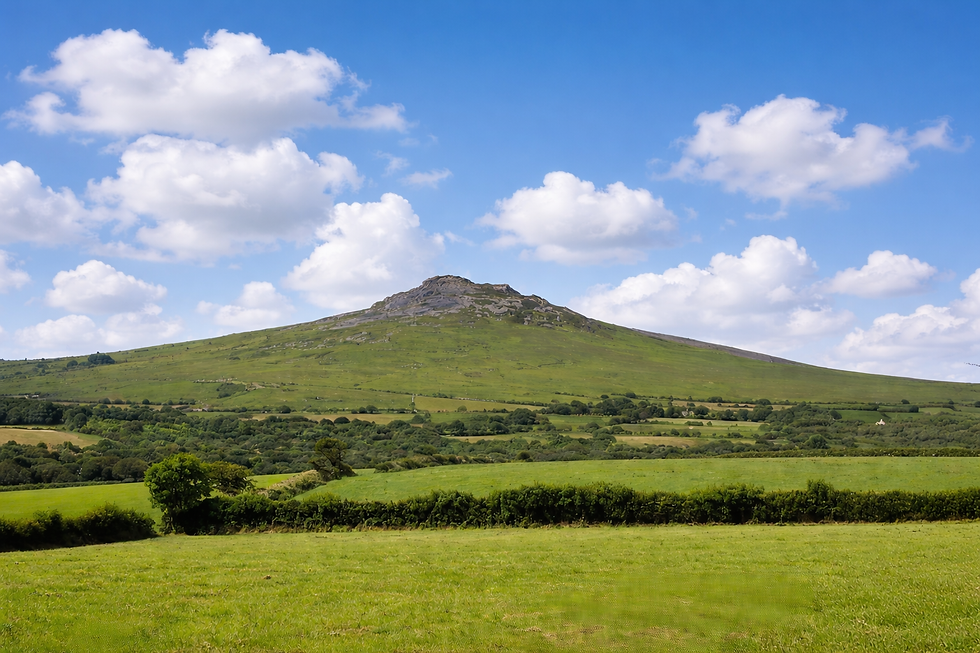
The Preseli Hills lend themselves to such ways of seeing. Their long ridges rise and dip with a slow, vertebral rhythm; their outcrops — Carn Menyn, Carn Ingli, Foel Drygarn — thrust upward from the turf as though the back of a great creature were breaking the surface. It is therefore unsurprising that modern descriptions reach for the same language. Even Welsh Government trail material notes that Carn Menyn is sometimes referred to as “the Dragon’s Back”. Such phrases are not evidence of ancient belief, but of perceptual continuity: enduring landforms continue to invite the same bodily comparisons, because their shape, scale, and movement through space consistently register as organic rather than inert.


Serpent Signs Before the Iron Age
If the Welsh dragon on banners belongs to the medieval and early modern world, the serpent-memory it carries is far older. Neolithic passage-tomb art already makes extensive use of sinuous, flowing forms that have long invited serpentine readings. At Bryn Celli Ddu, a decorated stone often referred to as the Pattern Stone carries curving, undulating designs. The original is now held in the National Museum Cardiff, with a replica standing at the monument itself. (5) These twisting lines show that snake-like movement formed part of the sacred visual repertoire of these islands long before the Iron Age, not as depiction, but as recurring formal logic.
In the Boyne Valley, the kerbstones of Knowth include sinuous and coiling motifs within the wider corpus of passage-tomb art. Such forms are recognised within standard typologies of megalithic ornament and sit alongside spirals, meanders, and undulating lines that recur across the Atlantic façade. These motifs were already read as serpentine by early antiquarians and continue to invite that reading today because the movement they render echoes the coiling, flowing logic of a snake translated into stone. Comparable curvilinear forms appear in the monuments of Carnac and in Neolithic Portugal, as well as elsewhere in Europe and the Near East, suggesting a durable visual habit grounded in form and perception rather than an isolated or site-specific symbol.

By the Late Iron Age and into the early medieval period, the serpent motif resurfaces overtly in northern Britain. The Pictish serpent-and-rod symbol, carved on stones from Angus to Shetland, demonstrates the motif’s continuity and re-articulation within a different cultural grammar. Read together, Neolithic curvilinear art and the later Pictish stones suggest a credible through-line: not an unbroken doctrine, but a persistent habit of associating coiling, sinuous form with power, danger, and transformation. That lineage can be traced not as belief, but as visual logic, echoing faintly in the lifted profile and flowing mass of the capstone at Llech-y-Drybedd.
Returning to the Dolmen
Walking up through the long grass toward Llech-y-Drybedd, these thoughts lingered just below awareness. They were not arguments so much as sensations: a quiet persuasion carried in slope and stone. The capstone sharpened into view, I was scepticalat first as can be heard in the video below, but my encounter has hardened into this essay since. A possibel snout testing the air, echoing the serpent-form traced across the Preseli skyline. Below it, the land lay folded and ridged, restless in its contours, less a backdrop than a body.
ycWhether or not the builders named such forms as dragon or wyrm seemed beside the point. The monument drew instead on a deeper grammar of serpent and earth, stone raised in acknowledgement of the living ground beneath. Standing there, between pasture and sea-wind, the mythic and the tangible braided together. The capstone’s weight rested not only on its uprights, but on older stories held within the ridge itself.
Measurement, Orientation, and the Horizon
Setting mythic musing aside, independent researcher Robin Heath has made a number of specific claims about Llech-y-Drybedd, situating it within what he describes as a wider “landscape temple” articulated through geography, geometry, and metrology. In his book Bluestone Magic, Llech-y-Drybedd appears repeatedly, underlining the importance he assigns to the site within the Preseli complex. One strand of his work is especially relevant here: its proposed archaeoastronomy.

Using a theodolite and astronomical software, Heath reports that the long axis of the capstone is aligned toward the midsummer sunset as it would have appeared around 2800 BCE. Looking west from the dolmen, the sun would set beyond the Irish Sea, its foresight lying some ninety miles away in the Wicklow Mountains. From this position, the Preseli ridge lies behind the observer to the east, while the setting sun sinks toward Ireland.
Heath further suggests that the midwinter sunset shines through the dolmen itself. If intentional, these paired solstitial effects would only be visible from a narrow strip of land, and Llech-y-Drybedd sits squarely within it. Whether the result of deliberate design or coincidence, the convergence of orientation, horizon, and season is striking.
Is Llech-y-Drybedd a Lunar Observatory?
Heath has also suggested that Llech-y-Drybedd may have formed part of a wider scheme for observing the Moon. He points to the prominent mound at Y Gaer, often described as an Iron Age hillfort, though with features that remain unusual and a tumulus of uncertain origin. According to Heath, this mound lies on a sightline with Llech-y-Drybedd that would have framed the major lunar standstill moonset as it occurred around 2800 BCE. On this azimuth, the Moon would have appeared to sink toward, or visually merge with, the dolmen’s capstone.
Intriguingly, this same line extends beyond the dolmen to a henge associated with Y Gaer, creating a three-point relationship of tumulus, dolmen, and henge. Whether this represents intentional design or later pattern recognition remains open to question. In a landscape where alignments tend to accumulate rather than appear in isolation, however, the configuration invites at least a second look. (6)
Such lunar claims have not been widely accepted within academic archaeology and should be treated with appropriate caution, particularly in a landscape so densely populated with prehistoric monuments that coincidental alignments are statistically likely. Even so, they introduce a provocative lunar dimension to an already complex setting, one in which horizon, monument, and long-cycle celestial events may occasionally have intersected in ways we do not yet fully understand.

Conclusion — Atmosphere and Setting
There is a serenity here that Pentre Ifan lacks — not the grandeur of a stage, but the intimacy of a chamber. Where Pentre Ifan feels like a hinge between worlds, Llech-y-Drybedd feels like a held breath, a resting note in the Preseli score. The wind quiets around it; the field seems to absorb sound. You begin to sense that these stones were not arranged for spectacle, but for orientation — tuning the body to horizon, time, and light.
As I left, I glanced back from the gate. The dolmen stood alone against a wash of silver cloud, its outline mirrored faintly in the damp grass below. It looked less like a relic than a question — one that the sun still answers each year, when it falls once more into alignment, tracing the same line of sight that may first have drawn the builders’ eyes across sea and sky alike.
What remains, after myth and measurement are set aside, is the encounter itself. A place that continues to orient attention, to gather land and light into a single moment of regard. Whatever stories once clustered here, whatever intentions shaped the stones, Llech-y-Drybedd still does its quiet work: holding the body still long enough for the horizon to speak.
Dr Alexander Peach
2026
Stone Temple Gardening is built through fieldwork: walking, filming, photographing and testing prehistoric landscapes on the ground. If this work interests you, you can support future site visits and research here.

Notes
1. Historia Brittonum (9th century) records the legend of the red and white dragons beneath Dinas Emrys, where the red dragon — symbol of the Britons — defeats the white.
2. The dragon-banner was adopted by Welsh princes such as Cadwaladr ap Cadwallon (c. 655–682) and later by the Tudor dynasty, asserting descent from the early kings of Britain.
3. The Dilong or “earth dragon” of Chinese mythology dwells beneath the soil, controlling rivers and fertility — a global parallel for the earth-serpent motif.
4. In Greek myth, Python, guardian of Delphi, was the offspring of Gaia; its slaying by Apollo marks the conquest of raw earth-power by celestial order.
5. Amgueddfa Cymru – Museum Wales. 2025. Bryn Celli Ddu Pattern Stone – Collections Online. [online] Available at: https://museum.wales/collections/online/object/95e5c990-7616-3591-bb17-35bac4a62cf5/Bryn-celli-ddu-pattern-stone
6. Heath, R. 2010 Bluestone Magic: A Guide to the Prehistoric Monuments of West Wales. Cardigan: Bluestone Press.
In-text references
Eliade, M. (1964). Shamanism: Archaic Techniques of Ecstasy. Princeton: Princeton University Press.
Heath, R. (2010). Bluestone Magic: A Guide to the Prehistoric Monuments of West Wales. Cardigan: Bluestone Press.
Lewis-Williams, D. and Pearce, D. (2005). Inside the Neolithic Mind: Consciousness, Cosmos and the Realm of the Gods. London: Thames & Hudson.
Methodological Note
The approach taken in this essay is phenomenological and landscape-led. It begins from direct encounter with place and asks how form, orientation, movement, and setting act upon human perception. Monuments are treated not as isolated artefacts but as participants within wider fields of land, sky, horizon, and memory.
This method does not claim access to prehistoric belief, intention, or doctrine. It does not seek to reconstruct what Neolithic people thought, nor does it advance speculative explanations in place of archaeological evidence. Instead, it attends to how certain landscapes and structures continue to shape attention, imagination, and bodily orientation, and considers how such effects may have mattered in the past.
Archaeological data, typology, chronology, and survey are respected as essential foundations. Where interpretive material is introduced—mythological comparison, phenomenological description, or cross-cultural analogy—it is presented as a way of exploring continuity of perception rather than asserting historical causation or universal symbolism.
In this sense, the essay operates alongside archaeology rather than in opposition to it. Its central claim is modest but firm: that the imaginative power of place is itself a real and historically consequential phenomenon, and that any full reading of prehistoric monuments must take account of the landscapes they inhabit and the perceptual responses they continue to elicit.



Comments