The Landscape is the Stage: Stone Temple Gardening as a Philosophy of Attention
Updated: Jul 23
Landscape first, the monuments follow.

Welcome to Stone Temple Gardening.
Today we begin at West Kennet Long Barrow, but this essay is not only about West Kennet.
It begins there because it’s one of my favourite sites that I know well, but also because long barrows force the question at the heart of the Stone Temple Gardening method: why was this place chosen, shaped, marked, blocked, revisited and remembered?
Stone Temple Gardening is a way of looking at prehistoric monuments through the landscapes that held them. It asks how sacred landscapes were sited, constructed, maintained and expanded over time, and how monuments became part of much longer biographies of place.
West Kennet helps make my method visible.
The chamber draws us in. The stones, passage and darkness demand attention. Yet before we enter, the ridge, valley, river, springs, paths, hill and horizon have already begun to tell the story.
Most accounts begin with the monument. This essay begins outside, in the landscape.

Stone Temple Gardening: Standing at the Entrance
When I first began visiting Britain’s prehistoric monuments, especially Neolithic long barrows, I thought I was looking for monuments.
Over time, I realised I was spending longer outside them than inside.
I found myself lingering on the approach, looking back across valleys, following old paths, referring to maps and wondering why one ridge had been chosen rather than another. The monument remained important, but increasingly it felt like the final chapter rather than the beginning of the story. It was not only about concentrating on the monument itself. It was about looking around too.
That surprised me.
It also changed the questions I began asking.
Right Here, Right Now
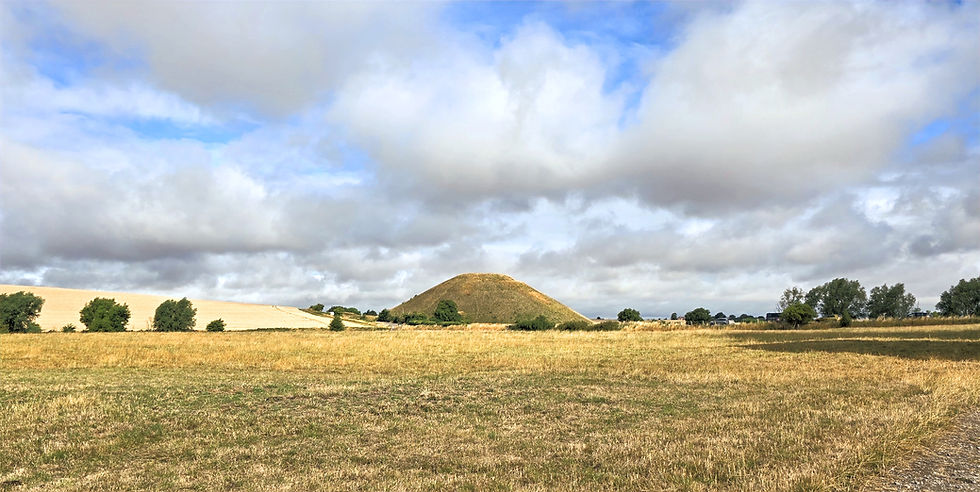
I am standing outside West Kennet Long Barrow looking towards Silbury and beyond Windmill hill. I have been here many times before, but now something has changed. I realise that in the past it had been too easy to begin in the wrong place. I was focused on the barrow, anticipating its form and interior, its strangeness and spectacle.
At the brink, the chamber draws us in. That is what they do.
The great stones, the entrance, the darkness beyond the threshold, the weight of the mound above them, all seem to say that this is where the story begins.
Most accounts tell us that we are looking at a tomb.
That is not wrong.
But before we have taken a single step inside, the landscape has already begun working on us.

The Land, the Horizon and the Monument
Behind me lies the lush Kennet Valley. Silbury Hill rises like a giant green pyramid below. Avebury itself is close enough to feel part of the same conversation. The river Kennet’s headwater springs emerge intermittently nearby. The track pulls the body upwards through flower-ribboned fields of wheat in a dramatic chalk landscape. The skyline is not background. It is one of the materials from which the monument was made. The long barrow slouches along the crest like a beached whale, its stone teeth nibbling at the ridge, not sitting in empty space, but occupying it. It belongs to a larger world of movement, memory, water, stone and sky.
For me, this is where Stone Temple Gardening begins, a landscape-first way of understanding prehistoric monuments through place, movement, memory and material. It begins by refusing to let the monument become the whole story. It asks us to begin with the landscape that made the monument possible, and only then to ask what the monument added to that place. It is as interested in movement between monuments as it is in the monuments themselves.
It took me some time to understand what I meant by landscape first, the monuments follow. I intuitively knew something, but it was a diffuse feeling rather than a fully crystallised thought.
I was not suggesting that monuments were secondary. Quite the opposite. A monument only becomes meaningful because it belongs to a landscape already rich in geology, water, movement, memory and horizon. The landscape is not a blank canvas waiting for architecture. It is the condition that gives the architecture meaning.
Landscape first simply means the story begins before the protagonist enters the scene.
But why gardening? A few people have innocently asked me whether STG is a garden business. I can understand the confusion; it is hardly the usual way to approach archaeology. But to paraphrase Robert Frost, taking the road less travelled has made all the difference.
I have been a keen gardener for decades, and gardening runs through my family. My great-uncle was a professional gardener and co-founder of the Shrewsbury Flower Show. Looking back, I suspect that heritage was quietly shaping my thinking long before I gave it a name. Memory and legacy have a profound influence on us all, even when they are half-forgotten.

Gardening taught me that places are never finished.
They are inherited, tended, altered and passed on.
A gardener is someone who recognises the potential of a place. They clear, plant, cut back, preserve, move, open views, close others, allow some things to grow and remove what no longer serves the design. Later gardeners inherit the work. They do not begin from nothing. They tend what remains, alter what they need, and leave traces for those who come after.
Gardens are not created by one act of construction, but by generations of care. Increasingly, I began to wonder whether prehistoric ceremonial landscapes were created in much the same way.
In practice, Stone Temple Gardening begins with the approach rather than the monument. It asks where the first glimpse occurs, how the ground rises or falls, where water lies, what the horizon does, what materials were selected, how movement is directed, and how later generations returned. It treats monuments not as isolated objects, but as features cultivated within older landscapes.
So Why Long Barrows?

I have found myself asking similar questions at stone circles, henges, chambered tombs, standing stones and burial cairns across Britain and Wales. Stone Temple Gardening is a way of looking that can be applied to many kinds of prehistoric monument.
This essay, however, concentrates on one monument type.
Neolithic long barrows provide perhaps the clearest place to begin. They are not the earliest traces of human activity in these landscapes, but they are among Britain’s first great acts of Neolithic monument-building: long, planned, visible structures that gathered stone, bone, earth, ancestry and horizon into a single design. My recent visits to West Kennet, Belas Knap, Uley, Nympsfield and Stoney Littleton made the pattern increasingly hard to ignore.
Recently, I have also been reading Timothy Darvill’s work on the chambered long barrows of the Cotswolds alongside Terence Meaden’s study of long-barrow orientations in north and mid-Wessex. Together, they gave archaeological shape to something I had already begun to sense in the field.
Darvill offered a way to see long barrows as places with long lives: opened, entered, blocked, reopened, filled, remembered and reinterpreted. Meaden added the other half of the picture: direction, horizon, season and sky.
Darvill’s work does not treat long barrows as simple containers for the dead. Human remains were deposited, rearranged, removed, redistributed and sometimes reintroduced. Chambers were reopened. Acess was managed and blocked. New walls appeared. Fires burned inside dark spaces. Pottery, flint, quartz, animal bone and other materials accumulated through repeated visits.
Eventually, many chambers were sealed, but even sealing was not simple abandonment. Blocking deposits themselves could contain meaningful material. Closure became another act in the life of the monument.
This changed the question for me.
A tomb sounds final. A long barrow, at least in many cases, was not final in that simple sense. It was a place of return. It was a place where the living encountered the dead, where remains changed status, where access was controlled, where memory was physically rearranged.
The dead were not always placed once and left alone.
Their treatment continued long after death.
That may sound strange to modern ears, but the archaeology repeatedly points in that direction.
Stone Temple Gardening therefore does not ask only, “What was this monument?”
It asks, “How did this place work?”

What Long Barrows Taught Me
At West Kennet Long Barrow, the question is not simply how the chambers were constructed or when the blocking occurred. It is how the mound worked within the wider Avebury landscape. How did the approach matter? What did the valley contribute? What did Silbury later add to an already charged place? How did closure change the meaning of a monument that remained visible? Why did later communities gather around earlier places rather than leave them behind?
If Darvill encouraged me to think about time, Meaden encouraged me to think about space.
Darvill’s monuments possess biographies.
Meaden’s monuments possess direction.
Together, they suggest that a long barrow was never simply a mound placed in a convenient field. It belonged simultaneously to history and landscape.
Darvill notes that the initial ground plan gave long barrows their principal axis. Meaden asks us to take that axis seriously. A long barrow has direction, and that direction opens the monument to its surroundings.
Meaden argues that many principal axes may relate to local horizons and seasonal solar events. Individual cases will continue to be debated, and they should be. But the broader insight is valuable: a monument’s axis does not stop at the end of the mound. It reaches into the landscape.
That is a profound shift.
It means architecture may include horizon. The shape of a distant hill, the notch in a skyline, the point of sunrise or sunset at a significant season, all may become part of the design. A gardener does not simply plant a tree anywhere. They plant it where the light will fall. Meaden reminds us that long barrows may have been placed with similar attentiveness to light, season and horizon.
This is not about turning every monument into an astronomical instrument. That would be too narrow. It is about recognising that orientation is one way a monument enters into relationship with its surroundings. The principal axis becomes a gesture. It points, frames, directs, remembers, or invites testing. It asks us to look beyond the stones.
The Landscape is the Stage


Belas Knap Long Barrow
The first time I visited Belas Knap Long Barrow, I did what most visitors do. I walked towards the great false entrance. Only later did I realise that the architecture had directed me there. The most dramatic part of the façade is not the way in. The real chambers lie elsewhere.
Whether we call that display, concealment, misdirection, ritual architecture or symbolic façade, it reminds us that a monument can direct attention. It can make the body move in one way while withholding access in another.
The façade, the forecourt, the length and the entrance are all more than their parts in the choreography of encounter. They all play a part in a wider drama.
That word, drama, needs care.
I am not suggesting that Neolithic people performed theatre in a modern sense. I am not imagining scripts, actors or audiences in the way we would understand them. But human beings are storytelling animals. Stories are not remembered simply because they are told. They are remembered because they are also performed.
We often remember journeys better than maps, the story better than the instructions, the emotional effect of places better than a list of their facts. Stories are remembered through feelings as well as words.
Prehistoric communities were also human, and, in that sense, no different from us.
Memory is the key here. If knowledge about ancestors, seasons, places and community was to survive across generations, it needed settings in which it could be repeatedly storied, enacted and remembered. Landscape can be more than background. It can become memory made physical.
The Rollright Stones
The Rollright Stones offer a striking example of how this process may continue long after a monument’s original purpose has faded. The tale of the king, his knights and the whispering knights turned to stone is almost certainly much later than the monuments themselves, but it still matters. It is a story of ambition, invasion, strife, battle-memory and the consequence of failure. It teaches as much as it remembers. The landscape becomes a warning as well as a wonder.
Visitors still move through the story, from the King’s Men to the Whispering Knights, following a remembered drama across the land. Whether or not the folklore preserves anything ancient, it demonstrates a powerful principle: stories attach themselves to places, and places help those stories endure.
In that sense, the Rollrights remind us that landscapes do not simply preserve memory. They help create it.
They become a stage for those most human of traits: constructing sense, memory and meaning from an unpredictable and ever-changing world.
To extend my dramatic metaphor, the monuments are scenery, but not merely decorative scenery. They shape what can happen. Pathways become entrances and exits. Forecourts become gathering places. Passages regulate movement. Blocking controls access. Seasonal illumination becomes lighting. Echo and enclosure become sound. Selected stones become props with biographies. Ancestors become recurring characters.
Every generation inherits the stage.
Some preserve it. Some alter the scenery. Some introduce entirely new monuments. Each performs its own understanding of the world, but never on an empty stage.
My preoccupation is not a replacement for archaeology. It depends on archaeology. Without excavation, dating, osteology, ancient DNA, stone analysis and landscape survey, the metaphor floats away. But with them, it becomes a way of holding different evidence together. It asks how structure, movement, material, season and memory combined as lived experience.
I have begun to think of this as landscape dramaturgy: an interpretive way of understanding prehistoric landscapes as places where movement, architecture, memory and story were repeatedly brought together.

Stoney Littleton Long Barrow
Stoney Littleton helps make this clearer. There I found myself slowing down almost without deciding to. The approach rises from the river, following a sinuous wooded passage that disappears into a hazy distance. Concealment creates anticipation. Then comes the reveal: bank, stone and fossil.
Passing beneath the giant portal stone, the passage narrows. Darkness increases. The body changes pace before the mind has fully caught up. The breath tightens. The contrast envelops you. The sun changes through time and season, but today it reaches the furthest chamber while deep pits of black loom on either side.
Stone scratches under the hand. Fossils and textures emerge, not as abstract geological facts, but as part of how the place is encountered.
The journey begins outside, but the monument intensifies it. It turns walking, bending, touching and looking into a sequence. By the time you reach the final chamber, a change has taken place.
A Welsh Wonder

My recent experience of Tinkinswood Chambered Tomb in Wales, worked in a different way, pulling my attention back to the building material itself. The immense capstone dominates the monument, almost forcing the visitor to look up and reckon with mass, balance and risk. Yet the smaller stones matter too. Their shapes, textures, colours and positions are not always easy to reduce to mere function. They gesture to recognised form, threshold presence, encounter and transformation. Why these stones marking the entrance? What associations might their texture, colour and shape have evoked? We know forecourts and entrances are a focus for ritual, so the question arises, how might these choices of material have been imagined?

Darvill’s work gives this question a secure archaeological footing. Stone selection was not always merely practical. Particular stones, materials and sources could matter. Stone Temple Gardening builds from that point and asks how selected stone qualities may have contributed to encounter, memory and meaning within the monument.
Increasingly I have begun asking whether prehistoric builders sometimes selected stones not simply because they were available, but because they possessed particular geological qualities. Quartz, fossils, unusual colours, textures, geological source, acoustic properties, reflective properties and, occasionally, naturally recognisable forms may all have contributed to why one stone was chosen over another. Not because every unusual stone was symbolic, but because prehistoric builders may have recognised qualities that some modern archaeology overlooks.
This is not an argument that every stone carried symbolic meaning. Rather it is an invitation to look more carefully at the relationship between geology, form and architecture.

Uley (Hetty Peglar's Tump) and Nymphsfield
Uley and Nympsfield long barrows reminded me that placement is never an afterthought. Both occupy commanding positions on the Cotswold escarpment, where monument and landscape become inseparable. Uley announces itself with the drama of its internal chambers and performative entrance. Nympsfield achieves something similar through quite different means. Its paired pointed and flat-topped uprights create a striking architectural frame. Darvill tentatively links such contrasts to symbolic sexual dimorphism, developing an idea first explored by Piggott and Keiller at Avebury.
Different monuments. Different landscapes. Different architectural solutions. Yet each returns us to the same questions.
Why this place? Why this arrangement? Why this journey?
Those questions lead beyond the monument itself and back into the landscape that first gave it meaning.
Stone Temple Gardening: A Landscape Remembers
Monuments became part of how later communities understood the land.
And their afterlives matter.
Darvill is especially strong on this. The end of the surprisingly brief long-barrow tradition was not simply a sudden rejection, as if one generation stopped believing and walked away. Their lives were longer and stranger than that. In the Cotswold-Severn region, many chambered long barrows were used broadly between c. 3700 and 3200 BC. During that time, they passed through several phases: construction, burial, revisiting, rearrangement of remains, blocking, reopening, final filling and remembrance.
But also, ceremony. Again and again, ceremony. The enactment of meaning.
Later, round barrows were sometimes built beside or over long barrows, as at Gib Hill near Arbor Low stone circle in Derbyshire. That was not reuse in a casual sense. It was a conversation with the past. Later communities were not simply finding old mounds in the landscape. They were inheriting places that had already gathered centuries of story. In that sense, long barrows did not really end. Their original role changed, but their presence continued to shape what later people built, remembered and imagined.
This is where the gardening metaphor and the stage metaphor meet.
What we might cautiously call a sacred or ritually significant landscape is not sacred in the sense of organised religion as we would understand it. I mean places set apart by repeated social, ceremonial and ancestral action. Places that were remembered, returned to, altered and inherited.
Such places are not created once and then frozen.
They are cultivated.
Some features are maintained. Others are blocked, buried, forgotten or deliberately transformed. New monuments grow around old ones. Old meanings fade but do not vanish. The landscape remains available for reinterpretation.
That, increasingly, is what Stone Temple Gardening is trying to trace: the long cultivation of sacred landscapes through memory, movement, monument and return.

West Kennet: The Return
When I visit a site today, I rarely begin with the chamber.
I stop.
I look back.
I look for the first glimpse.
I look for water, geology and horizon.
I ask how the monument reveals itself as I move through the landscape.
Only then do I turn towards the earth and stones.
Sometimes nothing remarkable follows.
Sometimes the landscape begins answering questions I did not know I was asking.
Increasingly, I have come to think of Stone Temple Gardening as a philosophy of attention. Its first discipline is simply to notice. It asks us to stand still before rushing inside. It asks us to look at the ridge, the valley, the spring, the horizon, the approach, the neighbouring monuments, the stone itself. It asks us to treat the monument not as an object alone, but as part of a cultivated landscape of memory, movement, material and meaning. It asks us to read the evidence archaeologists have given us, but also to ask how that evidence might have worked as experience.
The stones were never the whole story.
They belonged to places that had already been chosen, shaped and remembered. Those places were tended across generations, not unlike ancient gardens. They were also staged landscapes, places where communities could return, act, remember, close, reopen, conceal, reveal and begin again.
Standing once more outside West Kennet, I still see a chambered tomb. I still see remarkable engineering. I still see one of Britain’s great Neolithic monuments.
But I also see something I would once have overlooked.
The valley.
The springs.
The old paths.
The horizon.
The geology beneath my feet.
The generations who returned, altered, blocked, reopened and remembered this place.
The monument has not become less important. The landscape has just become impossible to ignore.
That, for me, is Stone Temple Gardening.
Not a theory that replaces archaeology.
A different habit of looking.
A way of asking different questions.
A reminder that before there were monuments, there were already places worth remembering.
Stone Temple Gardening is for stargazers in muddy boots.
Landscape first.
The monuments follow.
Alex Peach
Avebury, 2026
Stone Temple Gardening is built through fieldwork: walking, filming, photographing and testing prehistoric landscapes on the ground. If this work interests you, you can support future site visits and research here.

Author’s Note
This landscape-first approach can be applied not only to long barrows, but also to stone circles, henges, standing stones, passage graves and other prehistoric monuments explored throughout the Stone Temple Gardening blog.
If this essay changes the way you approach your next prehistoric monument, then Stone Temple Gardening has already begun to do its work.
Continue the Journey
If this essay has changed the way you look at ancient landscapes, explore the Stone Temple Gardening films below. They take the same landscape-first approach into the field, through walking, looking, questioning and returning.
Related Reading
Frequently Asked Questions
What is Stone Temple Gardening?
Stone Temple Gardening is a landscape-first way of looking at prehistoric monuments. It asks how ancient sites belonged to wider landscapes of water, stone, horizon, movement and memory. Rather than treating a monument as an isolated object, it begins with the approach, the view, the geology, the route, and the long life of the place.
What is a long barrow?
A long barrow is an early Neolithic monument, usually built as a long earth or stone mound. Many contained chambers where human remains were placed, moved and revisited. They are often described as tombs, but that is only part of the story. Long barrows were also places of ceremony, memory, ancestry and repeated return.
Why were long barrows built?
Long barrows were built for the dead, but not only for the dead. They created visible ancestral places in the landscape. People used them for burial, ceremony, remembrance and return over generations. Their placement, orientation, entrances, chambers and later blocking suggest that they helped communities organise relationships between land, ancestors, memory and belonging.
What is landscape archaeology?
Landscape archaeology studies ancient sites within their wider surroundings. Instead of looking only at a monument or settlement, it asks how places relate to rivers, hills, routes, fields, geology, visibility, resources and neighbouring monuments. It helps us understand how past communities lived within, moved through and gave meaning to whole landscapes.
How does Stone Temple Gardening differ from landscape archaeology?
Stone Temple Gardening builds on landscape archaeology, but adds a more personal and interpretive focus on how places were cultivated over time. It asks how landscapes were chosen, shaped, revisited, remembered and reworked, rather like gardens. It pays particular attention to approach, horizon, selected stones, movement, seasonal light, memory and the continuing biography of places. It is not a replacement for archaeology, but a way of slowing down and noticing how evidence may have worked as lived experience.
Bibliography
Darvill, T. (2004). Long Barrows of the Cotswolds and Surrounding Areas. Stroud: Tempus.
Meaden, T. (2025). The Sixty Long Barrows of North and Mid-Wessex. University of Buckingham Press. DOI: 10.5750/UBPOB.16.
Barrett, J. C. (1994). Fragments from Antiquity. Oxford: Blackwell.
Bender, B. (1998). Stonehenge: Making Space. Oxford: Berg.
Bradley, R. (1998). The Significance of Monuments. London: Routledge.
Bradley, R. (2000). An Archaeology of Natural Places. London: Routledge.
Cummings, V. (2017). The Neolithic of Britain and Ireland. London: Routledge.
Fleming, A. (2006). “Post-processual Landscape Archaeology: A Critique.” Cambridge Archaeological Journal, 16(3), 267–280.
Ingold, T. (1993). “The Temporality of the Landscape.” World Archaeology, 25(2), 152–174.
Thomas, J. (1999). Understanding the Neolithic. London: Routledge.
Thomas, J. (2013). The Birth of Neolithic Britain. Oxford: Oxford University Press.
Tilley, C. (1994). A Phenomenology of Landscape. Oxford: Berg.
Whittle, A. (1996). Europe in the Neolithic. Cambridge: Cambridge University Press.


Comments